
Culture in Norwich: East Gallery
Culture in Norwich: East Gallery
Norwich is a city of creatives, where art is part of everyday life, from street art to museums to galleries. One of these galleries is Norwich University of the Arts’ East Gallery.
Discover this public art space for yourself in the Lanes, a pocket of creativity where independent spirit thrives. It’s free-to-visit, putting innovative contemporary practice at its forefront and inviting the public to immerse themselves. From photography to painting, sculpture to installations.
Their latest exhibition is no different. Olivia Sterling’s Pity the Meat! (27 February- 18 April 2026) explores the distortion of the human form alongside a Francis Bacon loaned by the Sainsbury Centre.
Here, we talk to Curator Claire Allerton about the show, East Gallery, and why it’s well worth a visit!
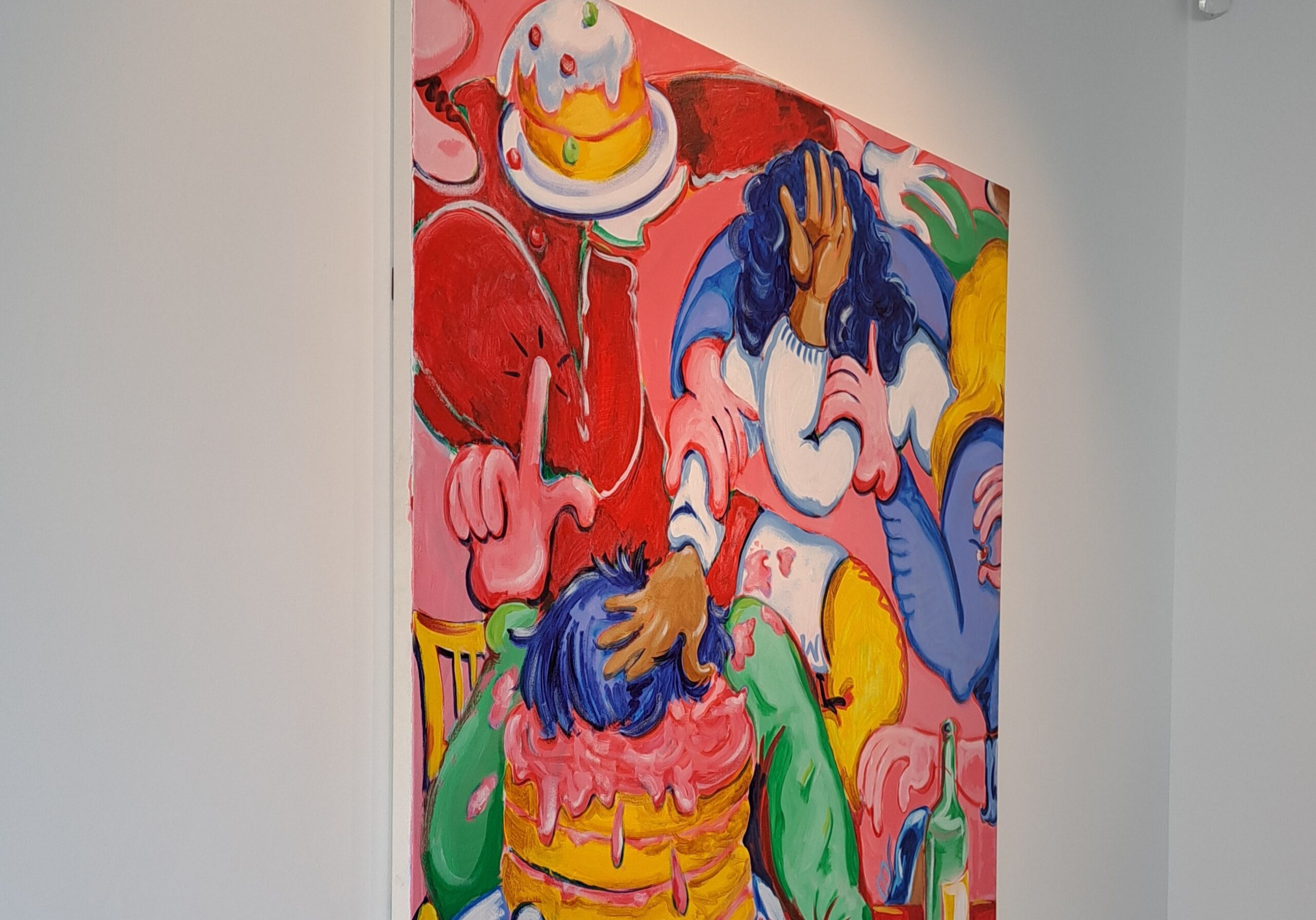
Olivia Sterling’s exhibition Pit the Meat! explore bodily distortion through societal pressures, such as race
East Gallery is a city centre gallery at Norwich University of the Arts. Tell us a bit about yourselves.
East Gallery is part of Norwich University of the Arts and sits right in the heart of the city. We are a professional exhibition space dedicated to showcasing innovative, ambitious, and often challenging contemporary art and design. Our aim is to support and enrich the student experience while also bringing exciting, thought-provoking work to Norwich and its wider communities.
We build on the legacy of EAST International, a pioneering annual open-submission annual art exhibition held in Norwich from 1991 to 2009 that brought globally significant artists to the region. That spirit continues to guide us today. We champion new, diverse, and sometimes underrepresented voices with the aim of inspiring creativity in all its forms.
Our exhibitions are developed through close collaboration with artists, designers, academics, and researchers. This allows us to present work that reflects current artistic practice while also engaging with urgent social, political, and cultural questions. As a university gallery, we embrace experimentation and risk-taking. We are a space where ideas can be tested, challenged, and shared openly.
Everything we do is free to access! Each exhibition is accompanied by a public programme of talks, workshops, seminars, and performances. These events give visitors the opportunity to meet artists, explore ideas in more depth, and experience something similar to university-level discussion without barriers to entry.
You’re known for inviting fresh perspectives and initiating challenging conversations. How do you decide which creatives and mediums to exhibit?
As Curator, I work continuously throughout the year, alongside a steering committee of arts professionals, to shape the East Gallery programme. It’s a thoughtful and detailed one that is driven by a curiosity and responsiveness to what is happening in contemporary practice.
We place a strong emphasis on variety. Each exhibition is conceived as a distinct experience, so across a year you might encounter g, sculpture, film, photography, textiles, or animation. This diversity reflects the breadth of teaching and research at the university and ensures audiences encounter something new with every visit.
We’re particularly interested in work that pushes boundaries, whether through material experimentation, new technologies, or by challenging established narratives within art and design. For example, we might present fine art that incorporates digital processes, or textiles that question traditional ideas of craft.
Supporting our academic community is also important. A recent example is Desmond Brett’s [Re]charge [Ex]change, which transformed the gallery into a live, evolving environment using two tonnes of clay undertaken at the end of his PhD at the Royal College of Art.
Collaboration plays a key role, too. By working with organisations such as Autograph and Film and Video Umbrella, we bring new voices into Norwich and connect local audiences with wider national and international conversations.
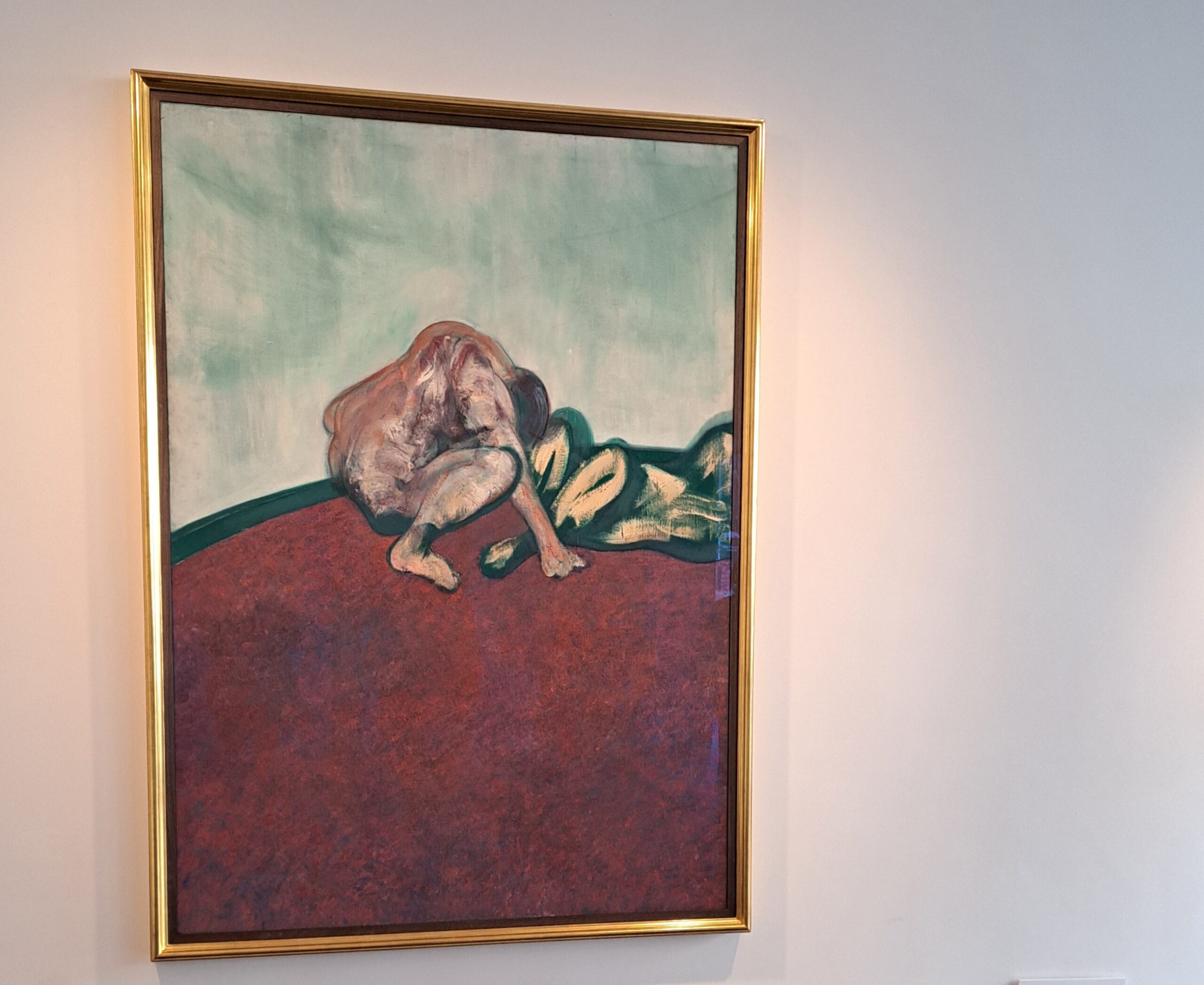
Sterling’s work sits in direct conversation with ‘Two Figures in a Room (1959)’ by Francis Bacon, loaned by the Sainsbury Centre
Tell us about your upcoming exhibition, Olivia Sterling: Pity the Meat!
This exhibition is a real highlight for us! We have collaborated with our neighbours at the Sainsbury Centre to present a compelling and ambitious show by emerging painter Olivia Sterling, alongside an extraordinary work by Francis Bacon.
Sterling has been called ‘one of the most exciting young artists working today’. Her paintings are immediately engaging, bold, graphic, and often very funny in a disarming and playful way. That humour acts as an entry point. Beneath it sits a sharp and critical examination of complex issues including marginalisation, race, identity, class, gender, and the tension between high and low cultural forms.
At the centre of the exhibition is a dialogue between Sterling’s work and Bacon’s Two Figures in a Room (1959), a key piece from the Sainsbury Centre’s collection. Bacon’s painting is intense, visceral, and psychologically charged, showing two figures caught in a moment that feels both intimate and confrontational.
By placing these works together, the exhibition creates a conversation across time. Bacon’s focus on internal, existential anxiety is reframed through Sterling’s perspective, which highlights the external pressures imposed on the body by society, particularly through structures of race and class.
Rather than presenting Bacon as a static historical reference, the exhibition brings his work into the present. Sterling’s paintings challenge and expand the conversation, inviting viewers to reconsider both artists in new ways.
What makes this exhibition stand out?
Art critic Eddy Frankel captures the energy of this pairing perfectly:
“[W]hat a match up. The singular, brilliant Francis Bacon, represented here by one stunning, tormented image of two bodies on the verge of being locked in the classic Bacon clash of embrace and brawl, brought into close, intimate dialogue with one of the most exciting young painters working today… They make for a perfect pairing. It’s red wine and steak, peanut butter and jam, beer and crisps. Absolutely delicious.”
What makes this exhibition distinctive is the immediacy of the dialogue between an established figure like Bacon and a rising contemporary voice. Two Figures in a Room is an important, powerful and emotionally charged painting. To encounter that work alongside Sterling’s vibrant and incisive paintings creates a dynamic viewing experience that feels alive and urgent. The contrast and similarities in tone, style, and context encourages visitors to look more closely and think more deeply.
It is also quite rare to see a historic work of this significance presented in such an experimental and responsive way. We are very grateful to the Sainsbury Centre for their openness in allowing us to work with their collection in this way.
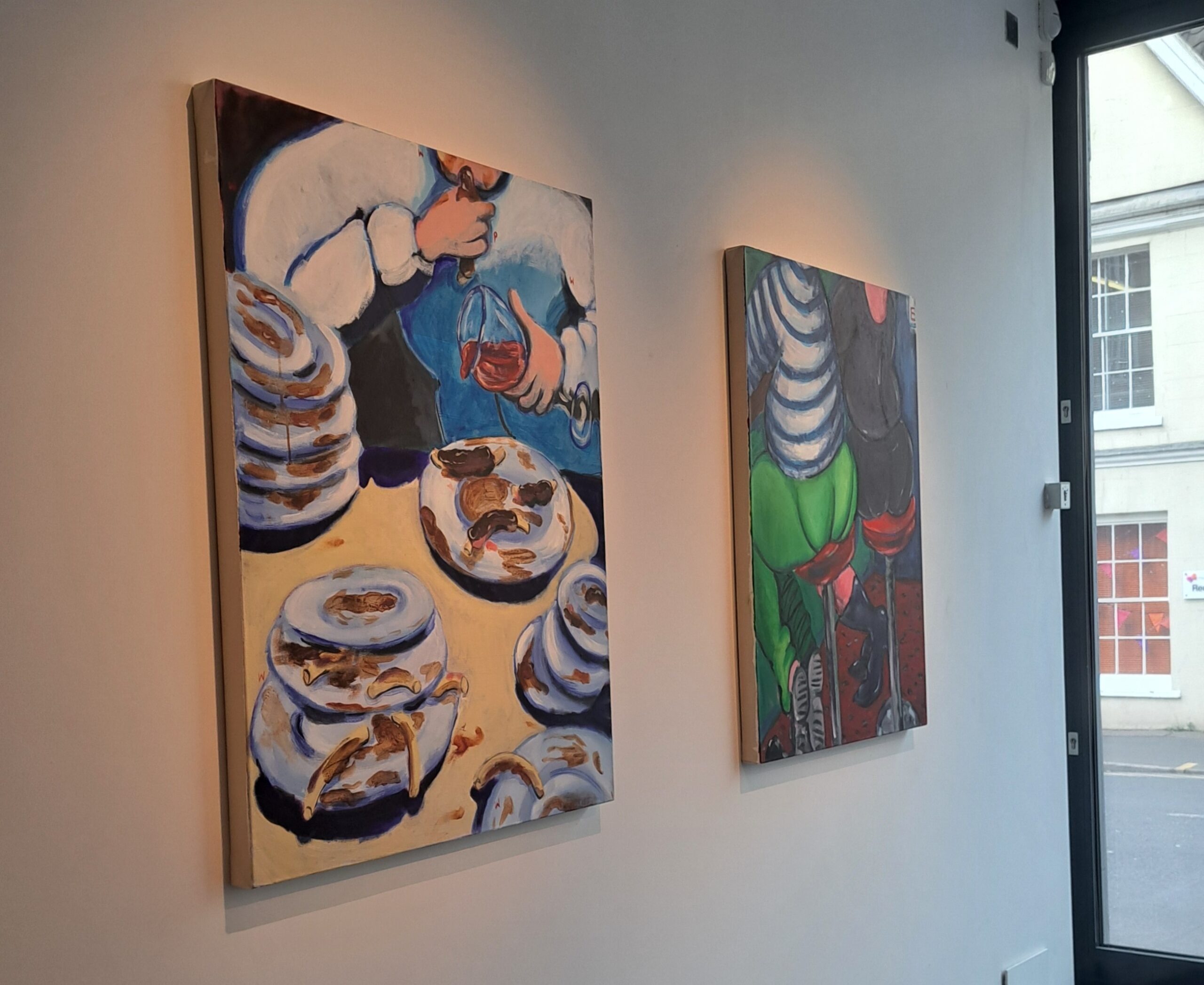
Olivia Sterling’s pieces are bold, graphic, and often very funny in a disarming and playful way
How do you hope this exhibition will impact visitors?
We hope visitors are first drawn in by the humour in Sterling’s work. There is a real accessibility to it that invites people to engage and spend time with the paintings.
Beyond that initial response, we hope the work encourages deeper reflection. Sterling’s paintings unfold gradually, revealing layers of meaning over time, much like a good book.
We would like visitors to come away with a renewed understanding of painting as a medium and of how it can be both humorous and deeply impactful. Her work highlights how the human body can be a site of societal tension, shaped by internal emotion as well as external pressures such as race and class.
Across all our exhibitions, we aim to spark reflection, discussion, joy, and sometimes discomfort. We want to encourage audiences to think critically about identity, power, and representation, and about the role art plays in bringing these issues into view.
For anyone who wants to immerse themselves in art in general, where should they start?
Start locally and follow your curiosity! Norwich is a uniquely creative city, full of artists working in studios, shared spaces, and unexpected locations, including our many historic churches!
Visiting galleries like East Gallery or the Sainsbury Centre is a great place to begin, as you can experience work first-hand and at your own pace. You might also dip in to open studio events and the amazing artist-led space, Outpost.
For me, one of the best times to explore is during the Norfolk and Norwich Festival, when the city comes alive with exhibitions, performances, and installations across a wide range of venues.
There is no right or wrong way to engage with art. The most important thing is to spend time looking, asking questions, and discovering what resonates with you.

East Gallery invites anyone and everyone to visit- it’s full wheelchair accessible and FREE
Are you an accessible gallery?
Yes, accessibility is a fundamental priority for us. East Gallery is fully wheelchair accessible, with a disabled access lift, a level access entrance, and a dedicated accessible toilet within the space.
We are committed to making our exhibitions and events as inclusive as possible. This includes careful consideration of layout, interpretation, and the overall visitor experience.
We are also happy to accommodate individual needs wherever possible. If visitors would benefit from quieter visiting times, advance information, or other adjustments, they are very welcome to contact us ([email protected]) and we will do our best to help!
What kind of audience does the gallery aim to attract?
We aim to welcome everyone! While the gallery plays an important role within Norwich University of the Arts and supports students and research-led practice, our programme is designed to be accessible to a broad audience.
You do not need any prior knowledge of contemporary art to visit. Whether you are deeply engaged in the arts or simply curious after passing by our huge windows, you’re welcome.
We try to create an environment that feels open and relaxed. You can spend five minutes or an hour, depending on what suits you. Our team is always happy to talk about the work, but there is no expectation to engage in a particular way.
We’re open Tuesday to Saturday afternoons, and our talks and tours offer opportunities to explore the exhibitions in more depth.
Finally, are there any exciting upcoming shows you can share with us?
We have a very exciting programme ahead! One highlight is an exhibition by sculptor Olivia Bax titled Wind Eyes, which will open as part of the Norfolk and Norwich Festival this year.
We’re also presenting the culmination of an East Gallery Fellowship project with Sutapa Biswas, who’s developing a new film featuring scenes shot at Norwich’s own Plantation Gardens!
Olivia Sterling’s exhibition Pity the Meat! is on until Saturday 18 April. East Gallery is open Tuesday – Friday during exhibitions and is FREE to visit. For more details on upcoming shows, check out their website and social media, and sign up to their mailing list for updates, invitations, and events!
