
Culture in Norwich: Living by the Rule
Culture in Norwich: Living by the Rule: Contemporary meets Medieval
Norwich is an old city with a new attitude. One where rich medieval history meets contemporary thinking. Nowhere is this more evident than the Sainsbury Centre’s current exhibition Living by the Rule: Contemporary meets Medieval, part of the innovative art museum’s season What is the Meaning of Life?
Curated by Dr Jessica Barker FSA, Senior Lecturer in Medieval Art History at The Courtauld, and Dr Ed Krčma, Associate Professor of Art History at the University of East Anglia, Living by the Rule explores how religious rule and routine still impacts our lives today.
Here, we speak to Jessica and Ed about this fascinating concept, find out about the years of planning, and discover which rare and important pieces we can’t miss- some on loan from our very own Norwich Cathedral and some which have not been together since the reformation!
Image: Andrea Büttner, Dancing Nuns, 2007
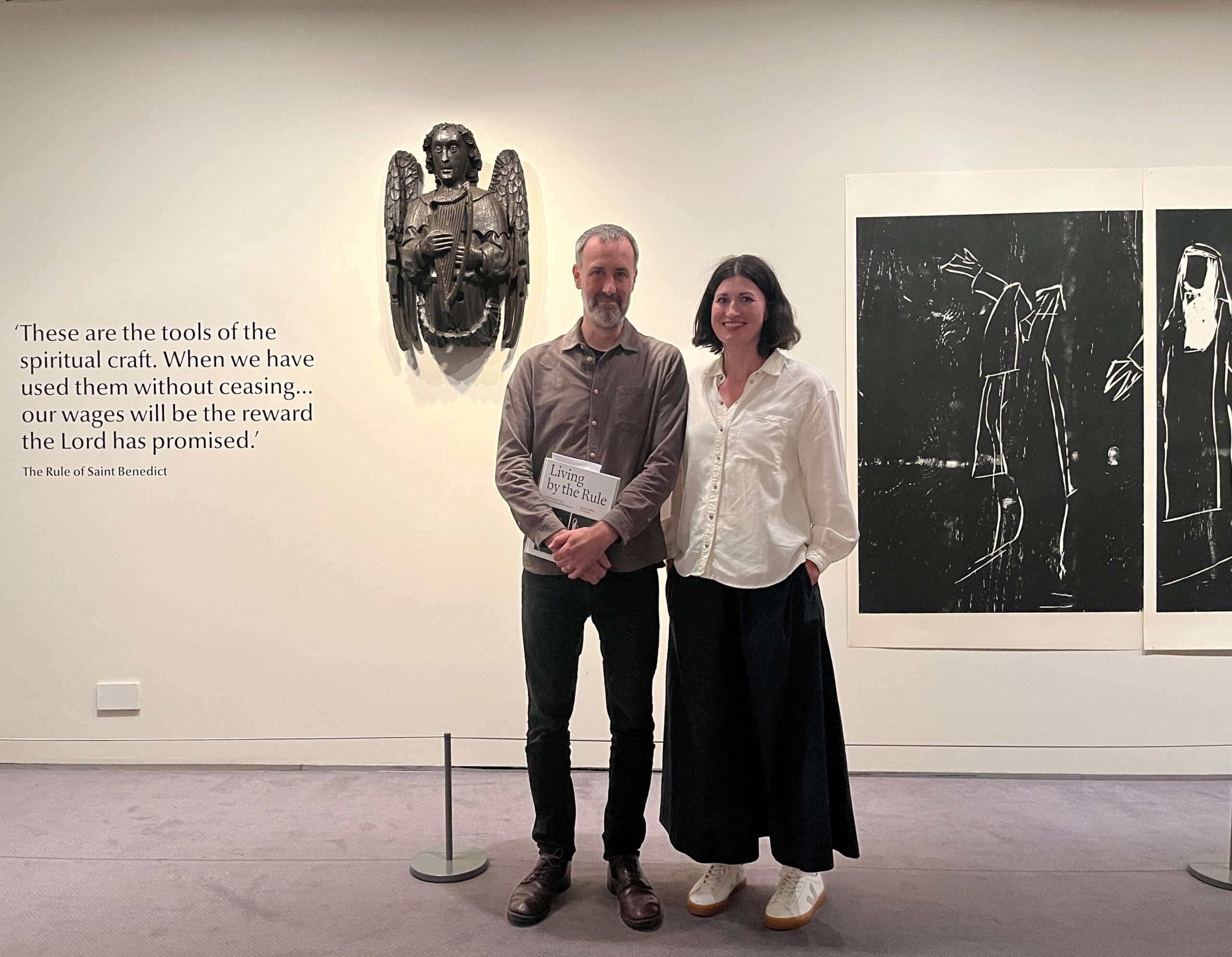
Years of research and planning went into the exhibition by curators Dr Jessica Barker FSA and Dr Ed Krčma. Image: Joost Jostra
‘What is the Meaning of Life?’ is possibly the biggest and most thought-provoking question the Sainsbury Centre has tackled yet. What led you to exploring this concept through the Rule of Saint Benedict?
It’s a big one alright! In part the question of life’s meaningfulness is about your horizons. What can you see as important, as possible, as worth working towards? Horizons of expectation vary enormously across time and space: different communities in different places and at different historical moments will have very different perspectives.
Today, the way life is organised isn’t often enough presented as a question. Why are things done the way they are, towards what ends, and how might they be done otherwise? Saint Benedict’s Rule provides an example of an extremely enduring model of shared living – it’s lasted about 1,500 years so far! – and one that can offer a completely different perspective on the way we live today.
‘Living by the Rule: Contemporary meets Medieval’ explores how religious routine and regulation still influences our everyday lives. Did you already have an idea of the objects you wanted to start with?
Yes- when we started to think about this exhibition and book, which was in 2022, we had a pretty clear sense of some of the contemporary artists we wanted to involve, as well as some medieval loans.
Two artworks we were thinking about right at the start were a medieval manuscript of the Benedictine Rule, with a table that allowed monks to calculate the time of day from the length of their shadow; along with a tapestry by contemporary artist Susan Morris which visualises her light exposure and activity levels over time.
We found out about other things as we went along, which was brilliant, and we felt lucky that we hardly had a single rejection from either an artist or a lender.
How does rule and regulation give meaning to our lives?
Probably the first thing to get away from is the idea that you either live by a ‘rule’ or you live freely.
What’s often called ‘freedom’ today is something like ‘doing what you want’. But how do we learn what we want, and what external forces influence that? Quite a few! So ‘doing what you want’ might seem more like a fantasy of choice amidst severe powers of domination, which doesn’t really amount to freedom.
We all live by some kind of rule, and, as citizens, employees, consumers, etc., our lives are regulated one way or the other. The challenge is how to take some ownership of the rules we live by, and to choose rules (as far as we can) that are more in line with how we think a good life could be lived.
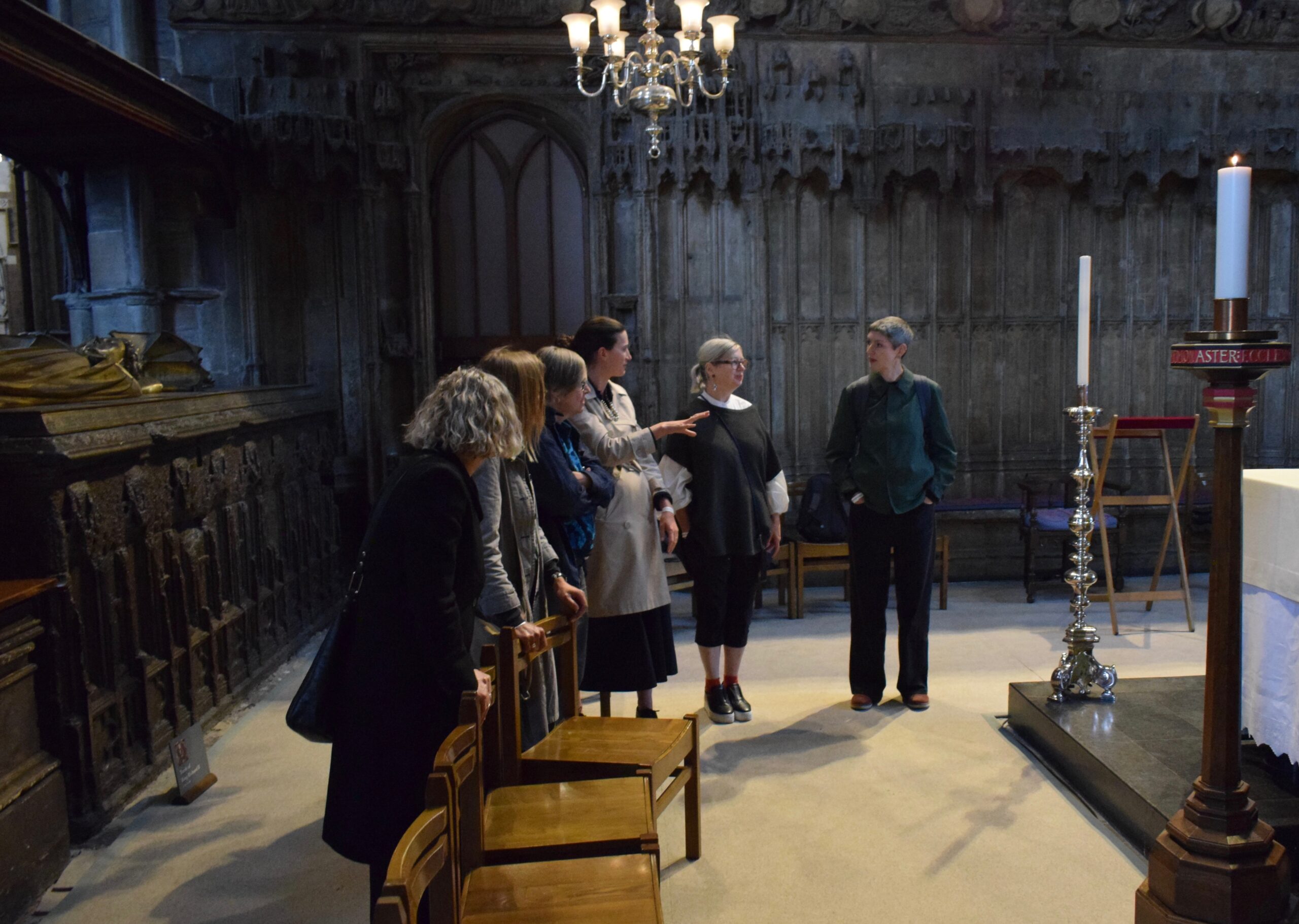
In the Confessor’s Chapel at Westminster Abbey in September 2024. Left to right: Susan Morris, Alison Turnbull, Andrea Büttner, Jessica Barker, Elizabeth Price, and Kate Pickering. Image: Dr Ed Krčma
Did you discover anything unexpected or surprising?
Oh, absolutely loads of things! We each learnt a massive amount from the years we spent working together on this project. One thing to say is how much knowledge, experience and beautiful ideas came to us from others: the artists we were in dialogue with, the curators and conservators who discussed with us the loans, the friends and colleagues we asked for advice, and the great team at the Sainsbury Centre.
We discovered important medieval objects hiding away in unexpected places- the choir stall fragments at Ely, for example, which have been hidden away up in the triforium at the cathedral there for over 150 years. We also learnt about artists working on particular ideas that we weren’t aware of – such as the great performance artist Kate Pickering, who wrote a new performance for our exhibition which weaves her own life story around the writings of Julian of Norwich and a medieval rulebook for anchoresses.
Take us behind the scenes. How much research and organisation goes into curating an exhibition as wide ranging as this one?
A massive amount. We first arrived at the idea of a medieval/modern show based on the Rule of Saint Benedict in 2022, and since then it’s been the main focus of our research, especially in the last two years or so.
On a practical level, to get some of these loans from cathedrals and major museums, you need to have your loan request letter in 18 months or so before the show is to open. To get to that point, you need to know not only what you want, but how you’re going to display it and why.
In order to work sensitively with contemporary artists, you need to know their work well, which takes time. Some of our relationships with artists go back over 15 years, and most for at least a few years. We also involved some of the artists in the show with the medieval objects – we went to see croziers (a bishop’s staff) at the British Museum with Elizabeth Price, and brought her, Andrea Büttner, Susan Morris, Kate Pickering and Alison Turnbull to Westminster Abbey.
Norwich isn’t short of its own fascinating medieval history. Tell us about the pieces on loan from Norwich Cathedral.
Incredible history, yes. We have Canon Peter Doll and Cathedral Archaeologist Roland Harris to thank for this- there are some amazing loans from Norwich.
Firstly, the worked stone: we have two 14th century pieces from the Ethelbert Gate, as well as some amazing 12th century capitals from the earlier cloister, which were repurposed as masonry and rediscovered later. The carvings on these are quite mysterious and some of them (the tangled vines and dragons) also seem to relate to the city’s Viking past.
Also potent but pointing to a different aspect of the life of the Cathedral Priory, is their seal matrix and its box. The seal was used to authenticate official documents and speaks to the communal identity of the monks. Lastly, and certainly one of the highlights of the show, are three psalters – books of the Psalms, which the monks would sing each week in their prayers – which were all made in, or owned by, communities at Norwich Cathedral in the 14th century, but only reunited again now, for the first time since the Reformation, for our exhibition.
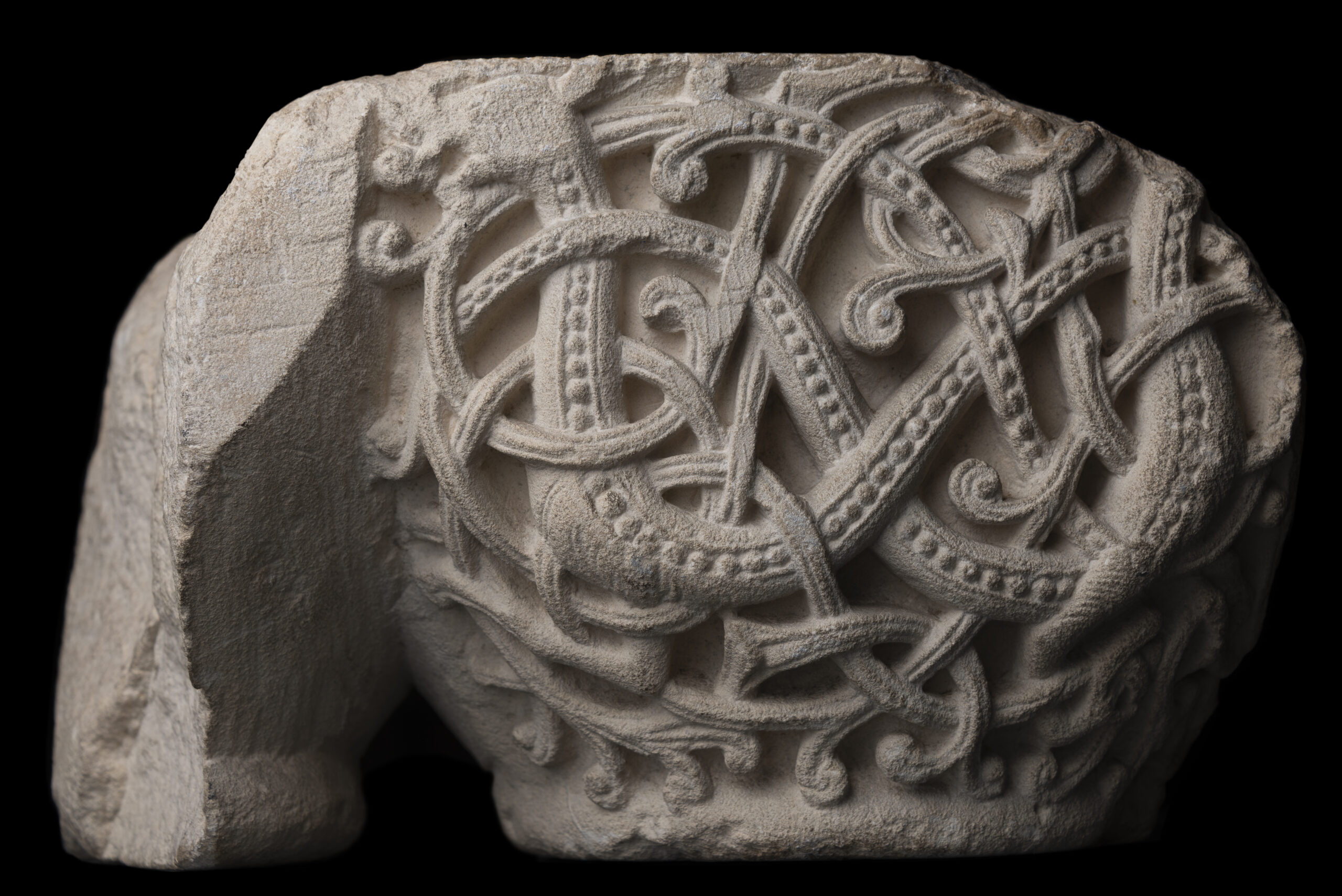
Cloister capitals, Norwich, 12th century. Courtesy of Norwich Cathedral. © Roland Harris
Elsewhere, we can see examples of female monastic leaders from the Middle Ages, a Turner Prize-winning short film and art influenced by apartheid. Why is it important for you to demonstrate ‘Living by the Rule’ across different religions, regions and genders?
As you can tell, the scope of this project was massive, so we did have to apply some limits.
For example, we tried to focus on specific monastic communities at particular times (Norwich, Ely, Canterbury), and we decided to focus specifically on Benedictine monasticism, in the knowledge that other religions have very deep monastic traditions too, and that within Christianity there are many different models of monastic life. But we also wanted to include alternative perspectives from the dominant one: in the medieval material, by focusing on women (Saint Etheldreda, especially), and in the contemporary work engaging with all kinds of different approaches and cultural reference points. These included work made during apartheid by the Jewish South African artist, Vivienne Koorland, and by others from a variety of backgrounds in terms of religion, ethnicity, and class.
When talking about a rule for living, or what makes life meaningful, there are of course many ways, and many different kinds of people from which to learn things.
Finally, there are some incredible surviving objects on display. Is there anything we shouldn’t miss?
Yes, we managed to secure some extraordinary loans of medieval works!
The psalters we mentioned are not to be missed – an extraordinary chance to see them in this setting. Equally rare is the San Zeno Wheel, an extraordinary late medieval timekeeping device, on show here before it disappears back into private hands. Also in the exhibition is the oldest copy of the Rule of Saint Benedict in the world (c.700 CE).
Then there are some of the more everyday objects from the archives: receipts for an early mechanical clock at Norwich, or documents showing the extent of monastic charity, or the records of a visit from the bishop containing the actual complaints and comments by monks on their life. And not to mention the opportunity to see so much amazing contemporary art too, which will never be shown together like this again… Not to be missed, even if we do say so ourselves!
Living by the Rule: Contemporary meets Medieval is on display at the Sainsbury Centre in Norwich until 4 October, and forms part of the season of exhibitions asking What is the Meaning of Life?
Jessica and Ed have also authored a new publication, Living by the Rule: Contemporary Art and the Medieval Monastery, published by Lund Humphries to accompany this exhibition.
