
Architecture in Norwich: The Norwich 12
Architecture in Norwich: The Norwich 12
by Katie Thompson
With Norwich’s rich history, it’s no surprise our fine city is home to a collection of eye-catching architecture. Steeped in stories, our cobbled streets see medieval marvels and modern gems stand side by side.
From strong flint walls to shining glass facades, the Norwich 12 shines a light on the City of Stories’ most iconic heritage buildings. Spanning an impressive 1000 years, Norwich Heritage Economic & Regeneration Trust (HEART)’s collection encompasses Norman and medieval eras, Georgian and Victorian times, Art Deco and 21st century design.
So, whether you’re an architecture aficionado or enjoy the beauty in different buildings, the Norwich 12 is a great place to start to uncover Norwich’s abundant past.
And if you want to discover even more about our city’s striking architecture (as well as the visionaries who designed it), make sure to join tour guide Paul Dickson’s Boardman and Skipper tour (£9)!
Norwich Castle (1067 – 1121)
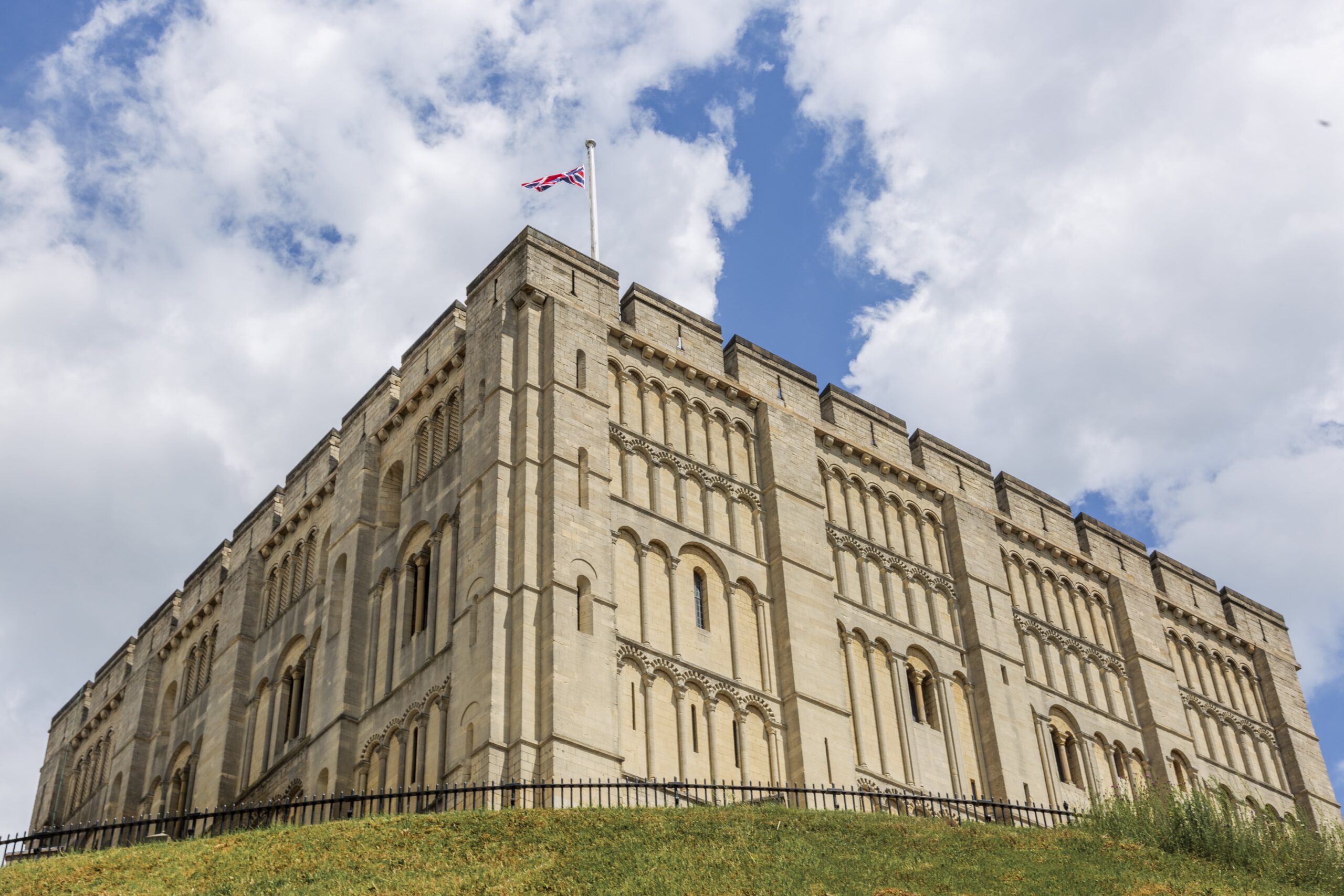
Norwich Castle is perhaps the most iconic of the Norwich 12
Founded by William the Conqueror, Norwich Castle is considered one of the best examples of Norman architecture in Europe! Constructed from Caen stone brought from Normandy (and sailed up the River Wensum), the stone Keep we see today was completed by 1121. Following a major redevelopment, the Keep reopened in 2025 as an authentic representation of a medieval royal palace, with its original floors reinstated.
Today, it’s the most accessible castle in the UK, taking you from basement to battlements. You can admire panoramic views across the city before discovering an incredible display of artefacts in the Medieval Gallery of Life (a partnership with the British Museum). And that’s not all, in the castle’s former Victorian prison, you’ll find exciting exhibits spanning Romans and Anglo Saxons, natural history, fine and contemporary art and more.
Open Monday – Sunday, 10am – 5pm, adults from £15.30, children from £13.05, twilight ticket 1 hour before closing £2.50. Book in advance online for the best prices.
Norwich Cathedral (1096 – 1145)
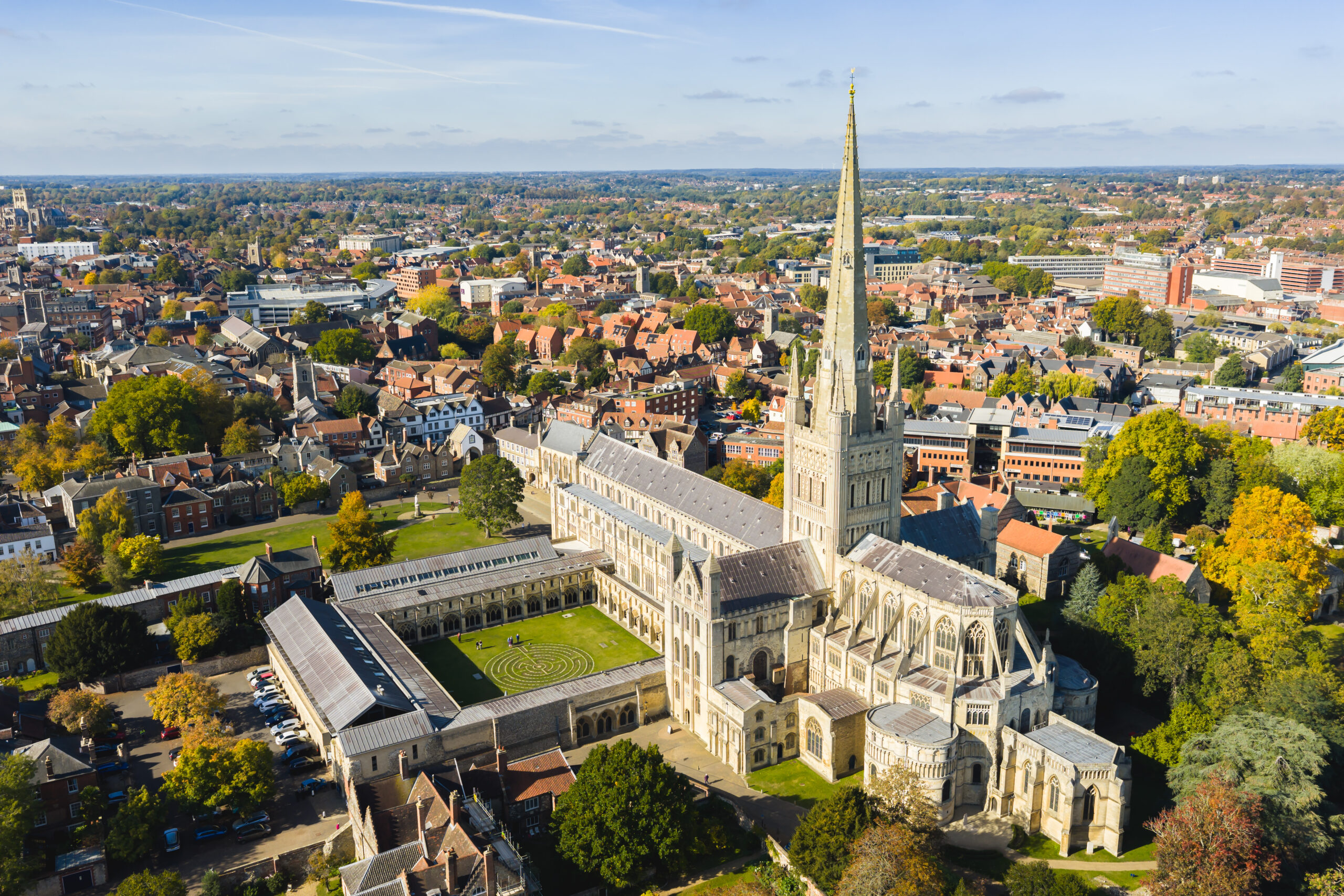
Norwich Cathedral boasts the second tallest spire in the UK!
The first of our city’s cathedrals, Norwich Cathedral is one of the most complete Romanesque buildings in Europe. Built with the same Caen stone as Norwich Castle, this stunning place of worship boasts the second tallest spire (home to a resident peregrine falcon family) and the largest monastic cloisters in the UK!
Take your time in this 900-year-old building, admiring the vaulted walkways, intricately carved roof bosses and impressive nave. While you’re here, we suggest a free 1-hour tour to discover its secrets, from blink-and-you’ll-miss-it graffiti to a vivid altarpiece saved during the Reformation. Follow this with a snack in the modern and airy, but sympathetically designed, Refectory Cafe, before a stroll around the charming cottages of Cathedral Close.
Open Monday – Sunday, 7.30am – 6pm, FREE.
The Great Hospital (1249)
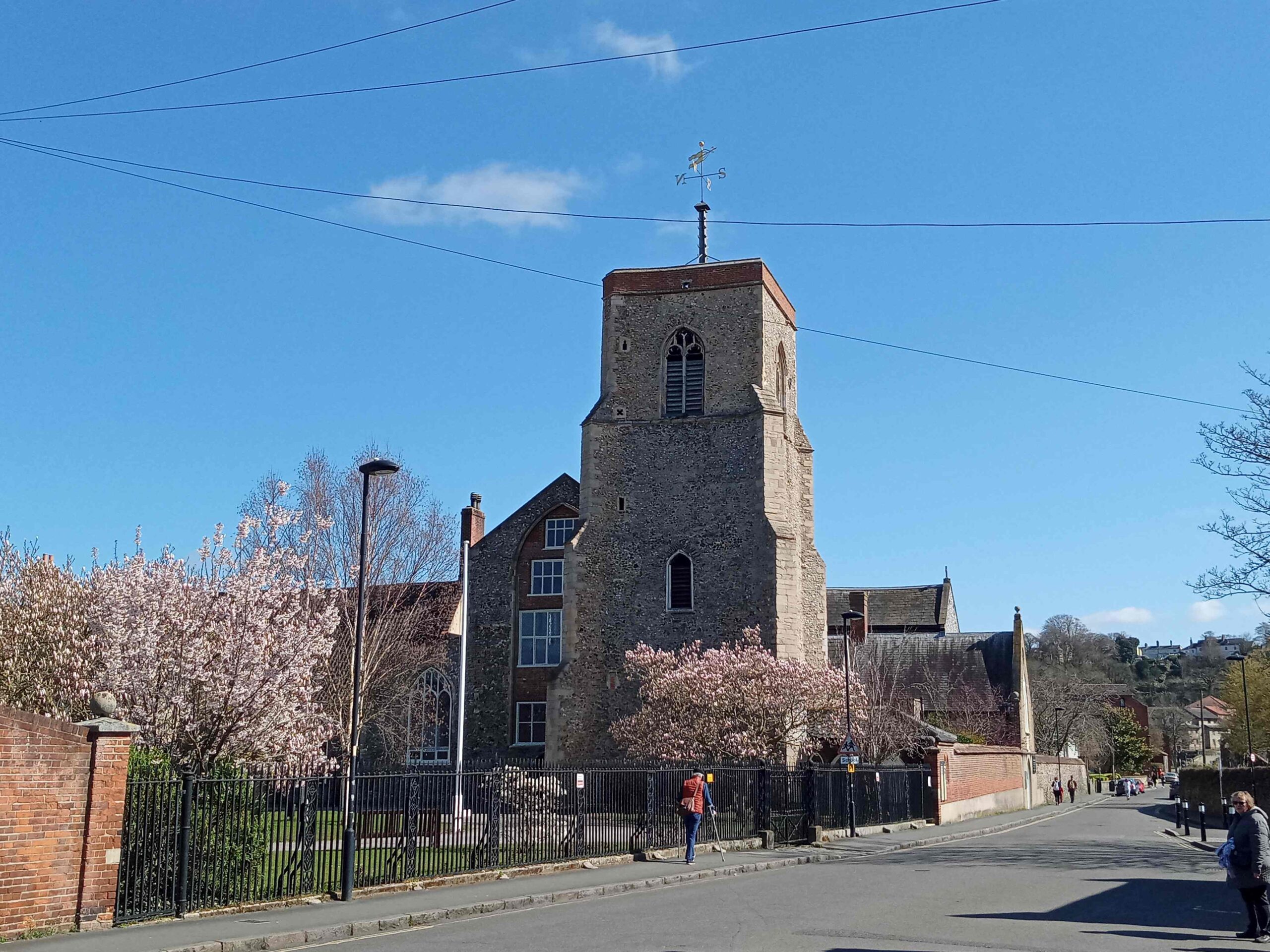
The Great Hospital’s cloisters are the smallest in England and St Helen’s church!
Situated in the shadow of Norwich Cathedral, near the River Wensum in Bishopgate, The Great Hospital was founded in 1249. As a religious hospital, the building follows a similar layout to monasteries and priories, with St Helen’s church at the centre of the complex.
As one of the city’s hidden gems, it’s well worth a visit. We recommend a tour to uncover the beautiful interiors of this unassuming building. From the domed ceilings of the Georgian St Helen’s House (added in 1751) to the smallest monastic cloisters in England and the hand painted eagles on the chancel ceiling of Eagle Ward.
Monthly tours available on the first Wednesday of every month, 10am – 11.30pm, £15pp.
The Halls (1307 – 1470)
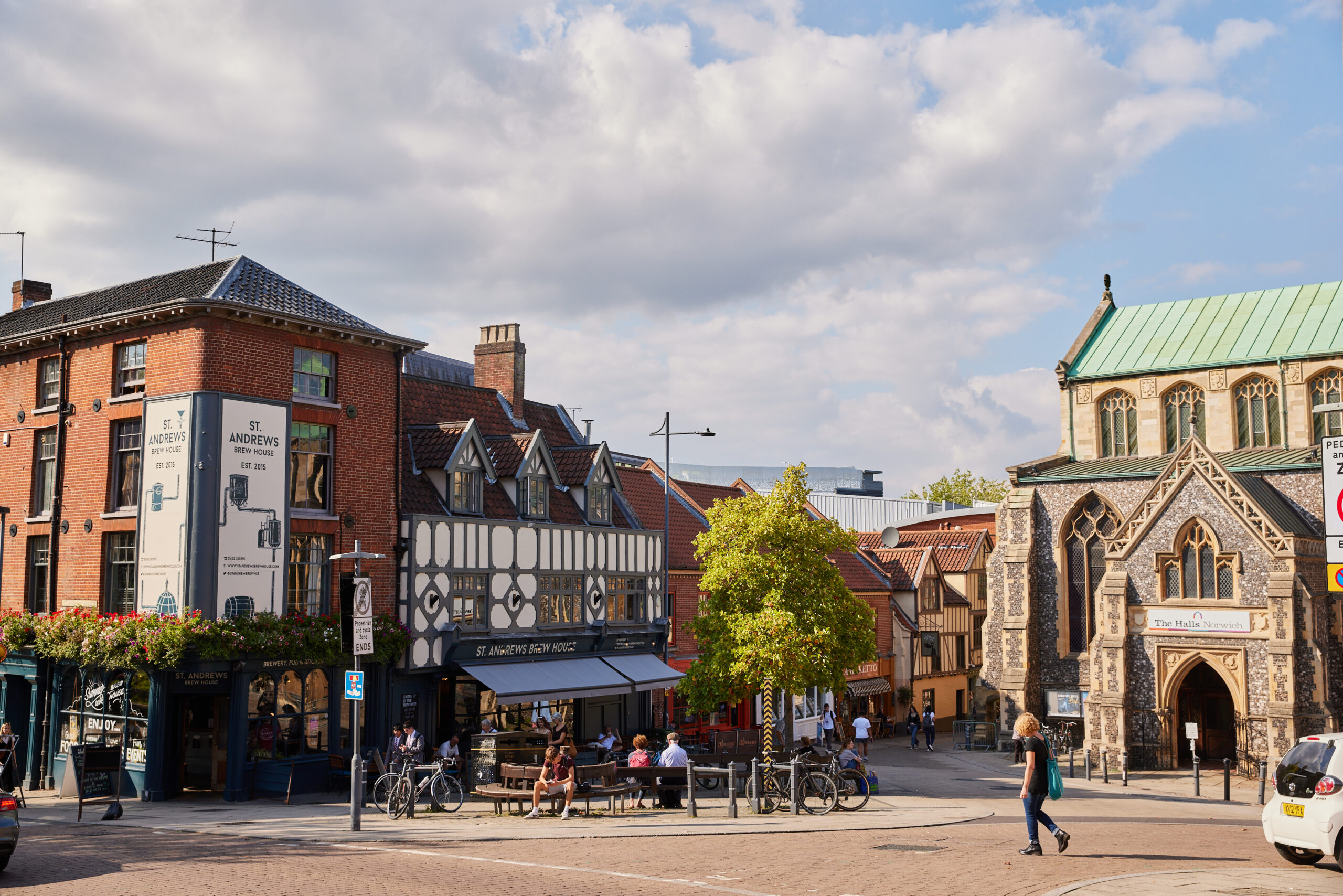
The Halls are the most complete medieval friary complex to survive the dissolution of the monasteries
The Halls are the most complete medieval friary complex to survive in England following Henry VIII’s dissolution of the monasteries from 1536 – 1541. Originally home to Dominican friars, the buildings were protected by three times Mayor of Norwich Augustine Steward and have since been home to a school, granary, workhouse, mint and now an events venue.
After restoration in 1863, The Halls’ Gothic porch was added, whilst its interiors boast stunning medieval simplicity, including St Andrew’s Hall’s hammerbeam roof, impressively high windows, and a crypt from the 13th century with one of the earliest known brick-vaulted ceilings in the country. The crypt is also home to the ruins of 13th century church Becket’s Chapel.
Following restoration work, The Halls will reopen for events in spring 2026.
The Guildhall (1407 – 1424)
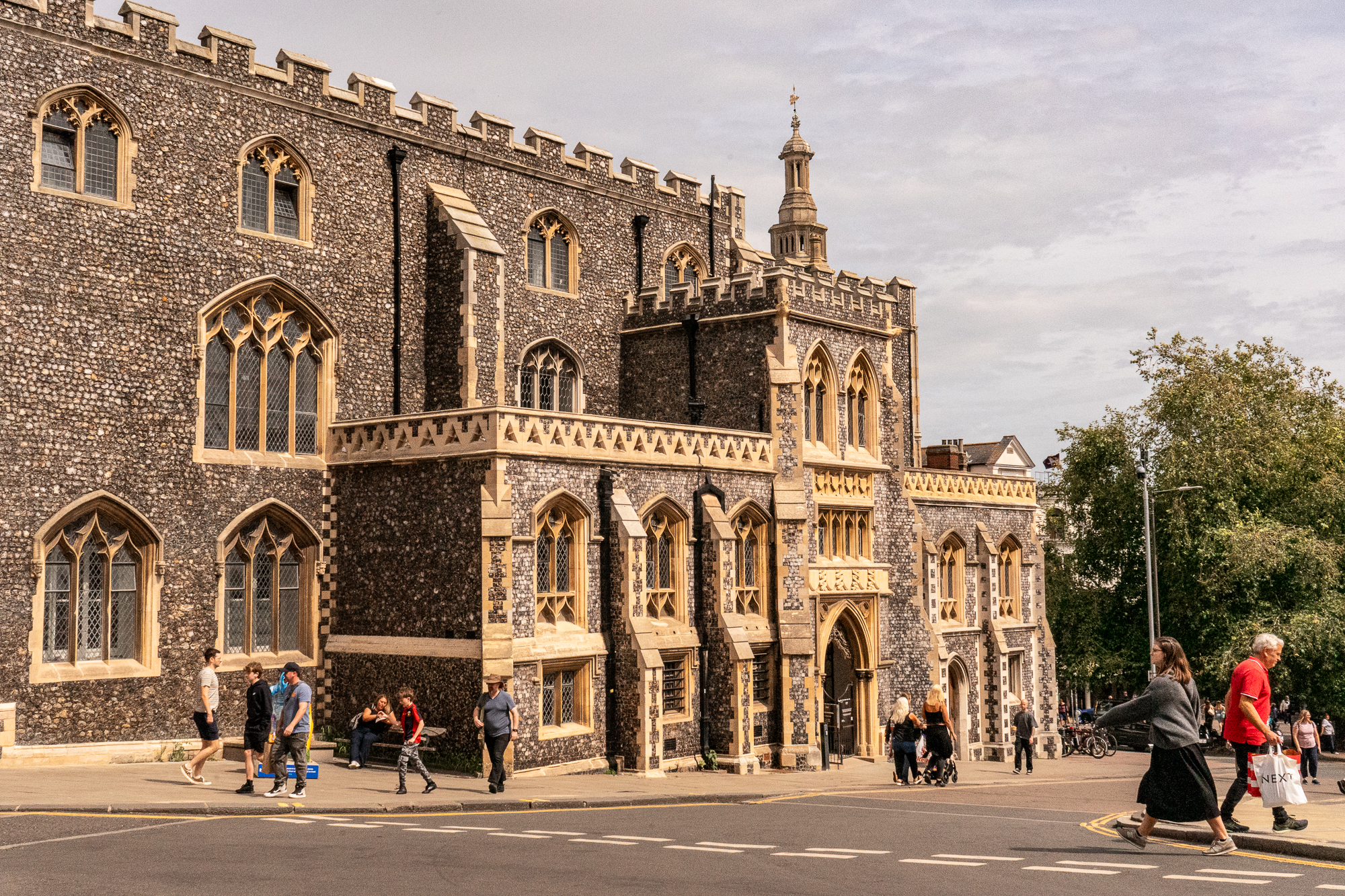
Norwich’s stunning Guildhall looks out over the marketplace
It’s difficult to miss the stunning flint-knapped facade of Norwich Guildhall, centrally located in our medieval marketplace. As England’s second city, the Guildhall was the largest and most elaborate medieval city hall seen outside of London, whose design was influenced by the city’s trading relationship with European’s Low Countries (now Belgium, the Netherlands and Luxembourg).
As the centre of government from the early 15th century right up to the 1930s, Norwich Guildhall is recognised for its distinctive chequered flintwork. Inside, the Guildhall resembles a church with a nave, chancel (with beautiful 16th-century oak panelling) and undercroft.
As home to the Norfolk & Norwich Festival, you can tour Norwich Guildhall on select dates and times across the year, 11am – 12.15pm, £5pp.
Dragon Hall (c.1430)

Dragon Hall is home to the National Centre for Writing
Dragon Hall is the only surviving medieval trade hall built by an individual, rather than a guild. Currently home to the National Centre for Writing, the building has been a townhouse, butcher’s, rectory and pub.
When you enter, see if you can find the dragons- there are 8 to spot, after which Dragon Hall is named. The main attraction is the building’s first-floor, 27-metre Great Hall. The stunning oak-beamed ceiling cleverly divides the room into two and in the 2000s, a modern glass gallery was added, showcasing medieval timber and brick arches.
Dragon Hall is open for guided tours on Mondays throughout the year, 2pm – 3.30pm, FREE.
The Assembly House (1754 – 1755)

The Assembly House is an example of stunning Georgian architecture
As one of Norwich’s most popular hotels and afternoon tea spots, The Assembly House brings Georgian grandeur to the city centre. Designed by local architect Thomas Ivory, The Assembly House was constructed in 1755 as a hub for entertainment and assemblies of the local gentry. These included balls, concerts, and even a waxwork display by Madame Tussaud.
Home to a series of impressive rooms, including a Grand Hall, the Noverre Ballroom and the Music Room, you can see opulent panelling, towering windows, elaborate plasterwork with floral details, grand ceilings and stunning chandeliers, all in a Georgian pastel colour palette.
You can stay and dine at The Assembly House all year round.
St James Mill (1836 – 1839)
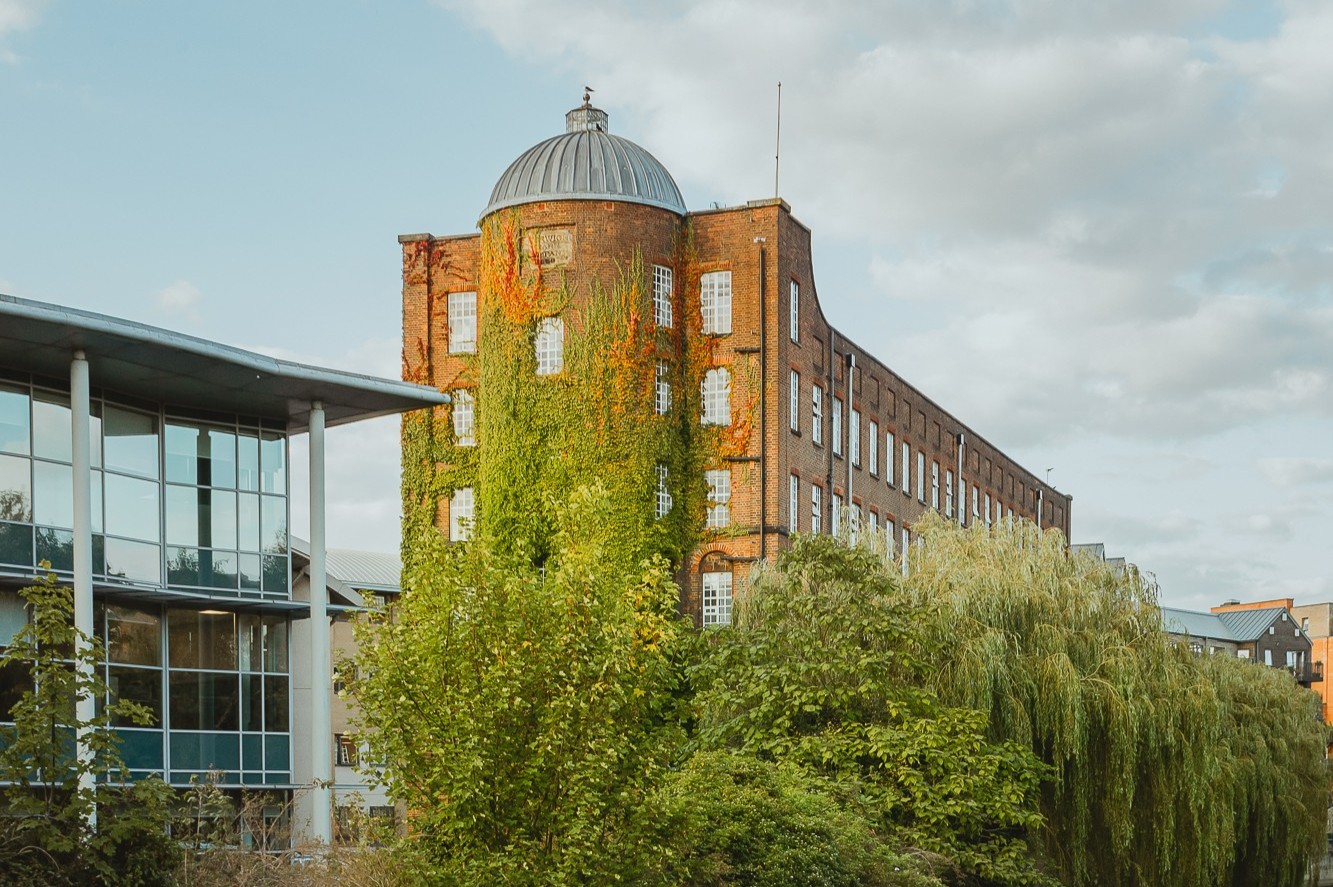
Spot St James Mill as you stroll along our riverside walk or paddle on the River Wensum
A picturesque landmark honouring Norwich’s once-thriving textiles industry, the ivy-clad St James Mill sits proudly on the River Wensum. Today, it’s owned by Norwich’s much-loved independent retailer Jarrolds.
Dating back to 1836, it’s regarded by many historians as being the prototypical Industrial Revolution mill, before being used as a printing works and chocolate manufacturers. At six storeys high, St James Mill is recognised by its domed west end, which tops a circular stone staircase.
The best way to see St James Mill is on our riverside walk on a sunny spring day.
The Cathedral of St John the Baptist (1884 – 1910)

The Cathedral of St John the Baptist is an impressive Victorian Gothic Revival building
The Cathedral of St John the Baptist is an impressive Victorian Gothic Revival building, making Norwich one of few UK cities with two cathedrals! Its architecture is majestic. We recommend a tower tour for a 360-degree view of Norwich. You’ll have to climb 280 steps of a spiral staircase to get there, but there is a resting spot on the way up, thanks to the crossing balcony.
Inside, the nave- 49 metres long and 18 metres high- is noted for its massive columns and stonework, serving to showcase the cathedral’s vibrant stained-glass windows. The windows themselves are some of the finest 19th century stained glass in Europe, detailing scenes from the Bible and faithfully restored after WWII bomb damaged. Throughout, Frosterley marble from Durham, made from thousands of small fossils, decorated columns, walls and even the font.
Open Monday – Sunday, 7.30am – 7.30pm, FREE. Tower tours take place at select dates and times for a small price.
Surrey House (1900 – 1912)
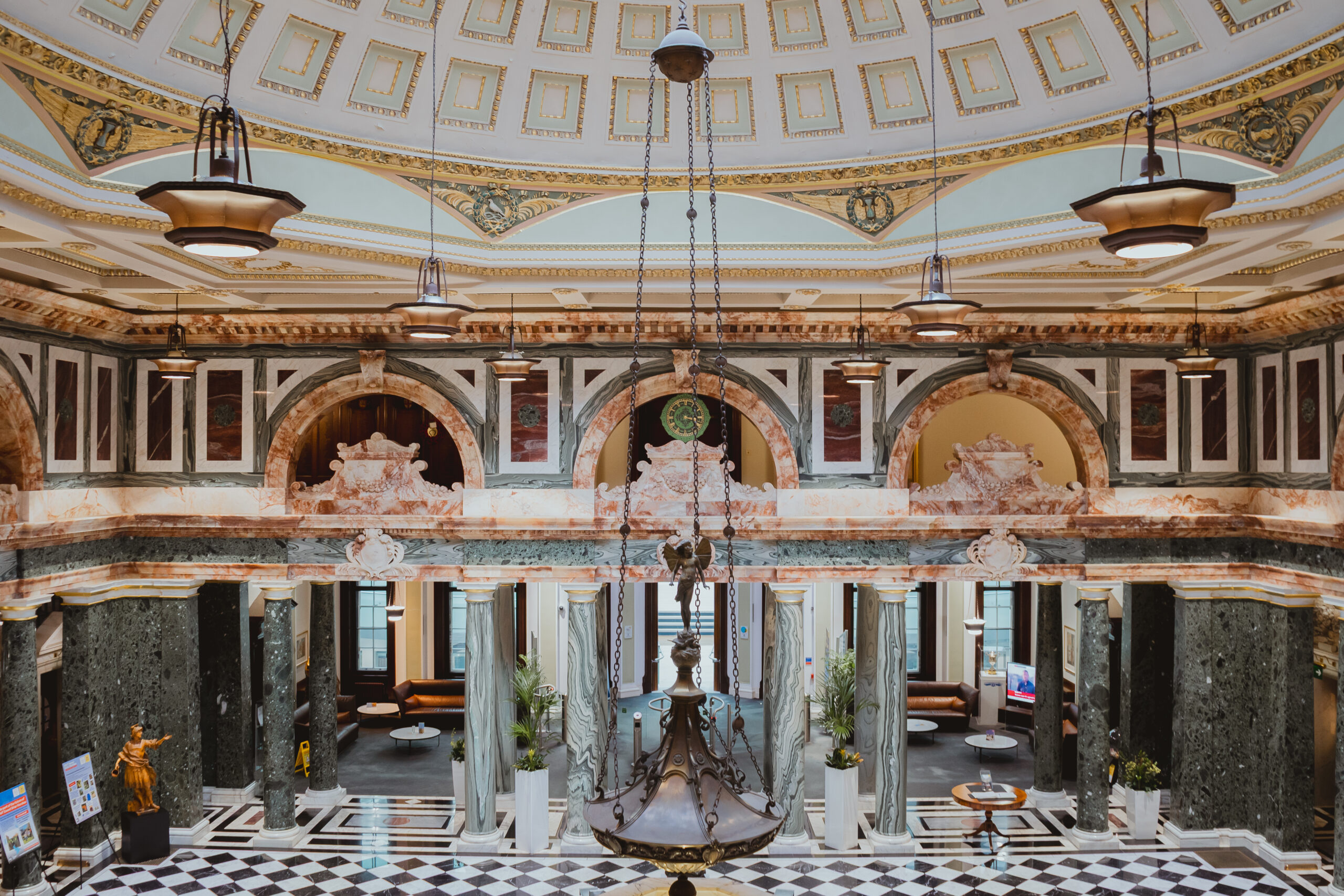
Inside Surrey House, you’ll find the stunning Marble Hall
Designed by local architect George Skipper (who also designed the Art Nouveau Royal Arcade and Jarrolds) for Norwich Union, Surrey House is a Grade I listed Edwardian building of architectural splendour (and now home to Aviva).
Through Surrey House’s grand Palladian entrance, you’ll be met by its opulent interior, Marble Hall. This stunning sight consists of 15 different types of Greek and Italian marble, originally intended for Westminster Cathedral. A domed entrance ceiling and columns add to the grandeur, as does a spectacular stained-glass window and stunning staircase. There’s also a beautiful skeleton clock, originally made for 1851’s Grand Exhibition. Beyond, various rooms are characterised by wooden carvings, chandeliers and floor-to-ceiling windows.
You can discover more with The Shoebox Experiences’ Magnificent Marble Hall tour (select dates and times, adults £16.50, children £8.50).
City Hall (1936 – 1938)

Norwich’s Art Deco City Hall looks out across our bustling marketplace
Looking out atop Norwich Market’s multi-coloured rooves, City Hall is an imposing Art Deco building opened by King George VI. It’s considered one of the finest municipal buildings of the inter-war period in England.
City Hall’s bronze entrance doors depict 18 plaques of Norwich’s history, while the entrance steps are flanked by two heraldic lions. The sky-high clock tower holds the largest clock bell in the UK. Although the public are unable to visit, City Hall’s Art Deco interior is spread across five floors, from a panelled council chamber to an ‘inverted cupola’ on the top floor flooding the building with light. The ceiling itself is a painting showcasing Norfolk wildlife.
The Forum (1999 – 2001)
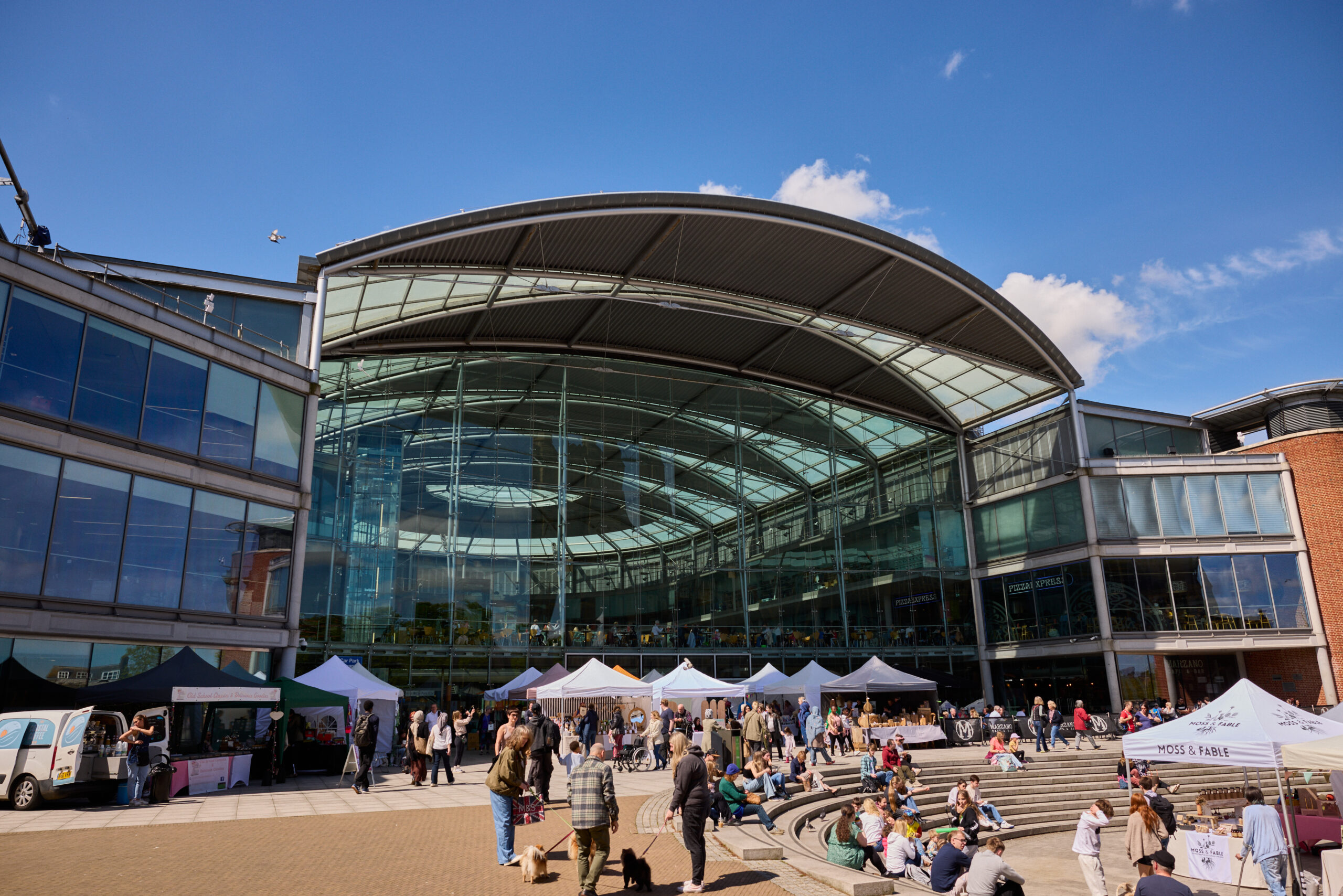
The Forum is a wonderful city centre events space recognised for its modern glass facade
Designed by award-winning architect Sir Michael Hopkins, The Forum is an eye-catching contemporary glass and brick building built to commemorate the millennium. Celebrating its 25th anniversary in 2026, The Forum is often host to exhibitions, festivals and fairs, as well as home to Norwich’s Millennium Library.
The three-storey Forum imitates an amphitheatre, with its bright horseshoe-shaped atrium surrounded by a series of balconies. It was built with sustainability in mind and contains a total of 1,235 panes of glass, the size of three football pitches! As well as stabilising temperature, the building reflects brilliant views of St Peter Mancroft in the sunshine.
Open Monday – Sunday, 7am – 12am, FREE.
