
Robert Kett
Robert Kett
by Ali Smith
Known as the leader of the 1549 rebellion, Robert Kett was a landowner moved by the plight of the poor to set up a rebel army camp atop Mousehold Heath. Today, he’s a local hero, who battled land enclosures and gave a voice to thousands.
Twenty Stories. One City. The City of Stories.
From medieval rebels and mystics to pioneering reformers, artists, entrepreneurs and unsung heroes, these are the people who shaped Norwich over 1000 years- and whose legacy can still be discovered across the city today.
All our stories are told by twenty invited guest authors from across our city’s creative, tourism and cultural community.
Delve into the series and discover the places linked to these incredible people- from museums and tours to cultural landmarks and green spaces. We kindly invite you to- Step Into The Story.
Image: Robert Kett, under the Oak of Reformation at his Great Camp on Mousehold Heath, Norwich, receives the Earl of Warwick’s Herald, August 22nd 1549 by Samuel Wale (1721-1786), oil on canvas, about 1740s; Norfolk Museums Service.
Stories Published So Far:
Jack Valentine | Emma de Guader | Pablo Fanque | Rumsey Wells | John Crome | Harriet Martineau | Julian of Norwich | Elizabeth Fry | Amelia Opie | Margaret Fountaine | Caroline Colman | George Skipper | Samuel Bignold | Anna Sewell | Margaret (Margie) Fahey McGrath | Margaret Paston | Edith Cavell | Sir Thomas Browne | Peter the Wild Boy
ROBERT KETT
1492 – 1549
As an American, you had me at rebellion when I first heard about Kett, the wealthy landowner who led a movement against corruption and wealth disparity in Norfolk in 1549.
The word is baked into my psyche as a positive. It evokes black leather jackets, as worn by Marlon Brando in The Wild One, fellow New York punks, The Ramones, and by me, when I want to tap into a younger, more rebllious version of myself. I’m here for Kett and his sixteen thousand agitators holed up on Mousehold Heath for 47 days.
Mousehold Heath. The poetry of the name is poignant. Sixteen thousand mice on a single plot of land would rightly be called a plague. In this instance, a plague of accountability, poised to descend upon, infest, and infect those most deserving of falling ill: greedy, corrupt landowners and politicians, clergy, preaching land-privatization and profit, bribe-takers, and the cream of the corruption crop, abusive “gentlemen.” (I’m looking at you, innumerable men in power.)
Kett seems like my kind of guy— a man of the people, an undeniable hit with common folk.
“Oh no,” a British-born pal, also in her 50s, corrects me when I compliment the UK’s education system for exalting a proletarian rebellion to all those tie-and-suit-adorned youngins. “Kett was NOT presented as a hero in my day. He was a cautionary tale about what happens to bad boys when they push against the norm.”
In Kett’s case, “what happens to bad boys” involves being hanged in chains and left to rot on public display.
Come again?
It’s seductive to see Kett’s (29) Demands Being in Rebellion as self-evident truths about fairness and equality that we’ve since grown into as a people, and the resistance to them as antiquated, almost quaint. But have we changed so much, really? Is inequity a thing of the past? Isn’t over 90% of the UK’s land currently inaccessible to the public? Aren’t rents too high universally and political-palms greased perrenially? And on the other side, isn’t young men’s
rage and corresponding sense of impotence still being exploited by those who stand to benefit? And how many of us are willing to take a metaphorical—or *literal—arrow in the ass for taking a figurative (or literal) dump at the feet of the king’s emissary? (* Look it up.)
Aren’t the wealthiest still sequestered on their estates, reimagined as fortified bunkers built on private islands? Rather than watchmen patrolling their perimeters, presumably it’s headless robot dogs by now. As technology advances, perhaps each quasi-canine will be able to recharge itself, indefinitely, on the fuel of a single orphan’s tear.
Who will be the Kett among today’s billionaires, the turncoat among the broligarchs? The tepid “we’re sorry” apologists, slinking away from careers built on creating the problems they now warn us about, don’t seem cut from such stern stuff. Unless, of course, unbeknownst to us, they’re funding grassroots rebellions with all the money they made creating the need for them.
Will it be the wispy, twitchy Zuckerberg, who commodified his INCEL-adjacent status in college into a level of power and influence that might have sent Kett’s antagonist, King Edward VI, into a flop sweat of admiration? Or Elon, who can barely contain his excitement when he realizes that he may never again have to interract with another creature he has not built from scratch and / or otherwise programmed? Will it be inexplicable lothario and notorious tortoise look-alike, Rupert Murdoch? Or—and forgive me for being so gendered here—may I pin my hopes on the lone woman in the bunch, if there is one? I recognize, as a woman, that it’s highly problematic to expect women to clean up the world’s mess. Sometimes, though, I just don’t know where else to look.
Sixteen thousand swarmed from the cover of the heath toward the ruling class, creating havoc and arguably catching up in their violence those who might have otherwise been their comrades. They were rebels, after all. Pacificsts don’t tend to join in with such things. But their cause was true.
What would the logistics—the optics—of marauding hordes look like today, convening at the foot of one of these bunker compounds? Would it look like David aiming his sling-shot at Goliath’s shin instead of his forehead: ineffectual at best, setting himself up for a trauncing, more accurately?
None of us knows. But I’d propose that the odds may have looked just as bad when Kett erected his first fence to keep his future followers off his land, and one of them leaned over it and asked him, in no uncertain terms:
“Which side of history are you going to be on, mate?”
Step Into The Story.
A city you don’t just read about – you experience.
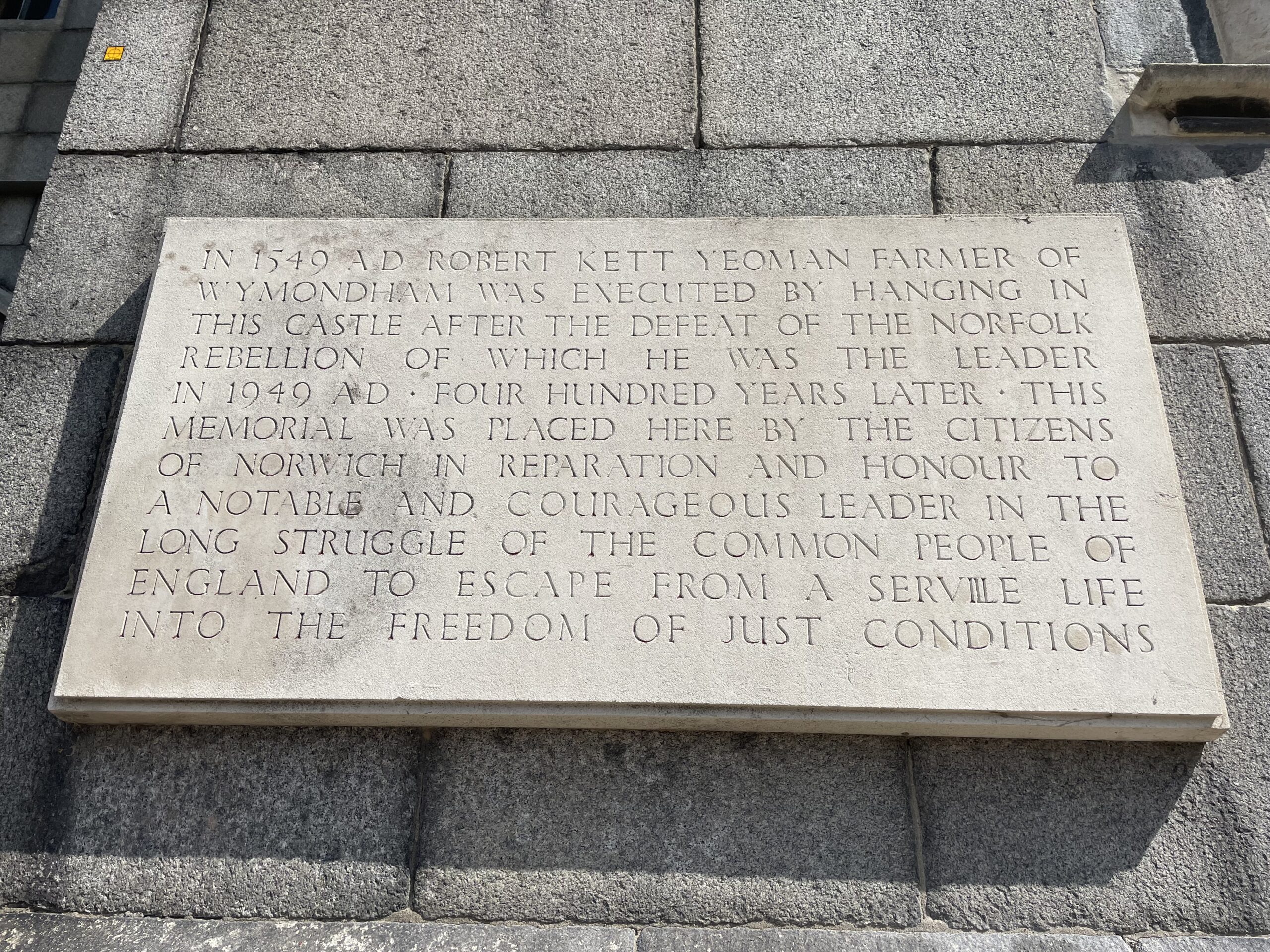
On Norwich Castle, you can see a plaque in honour of Kett’s execution. Credit: VisitNorwich
Robert Kett’s legacy is clear in Norwich and Wymondham, the town where he lived and worked with his brother William.
The 1549 rebellion was immortalised in C.J. Sansom’s best-selling final novel Tombland (named so after the area in Norwich’s Cathedral Quarter). To immerse yourself in this story, take Paul Dickson’s ‘Shardlake’s Norwich’ walking tour (2 hours, private tours available, £12pp, includes hot drink and biscuits at the Maids Head Hotel- which even havs its own room named Kett’s Keep after him!). Discover stories of the people and places featured in the novel, including a walk up to Kett’s Heights where the rebel army was based on Mousehold Heath.
On the exterior of Norwich Castle, you can see a plaque commemorating Robert Kett. It was on these walls that he was hung for being a traitor, after being held in the Castle gaol. Or at the Museum of Norwich, ask at reception for the VR headset to experience the rebellion for yourself (FREE)!
Further into Norfolk, you can visit Wymondham Heritage Museum, Wymondham Abbey and ruins, where Kett was linked, and Kett’s Oak, an historic tree on the B1172. There’s even Kett’s Country Long Distance Trail for a picturesque countryside walk.
Author bio: Ali Smith is an internationally acclaimed photographer, author and public speaker whose vibrant, emotionally honest work was shaped by growing up in New York City’s underground music scene. This Book Should Be Played Loud—to be released March, 2027, by Rizzoli—features Ali’s photos and stories from NYC’s downtown underground music and art scene, 1990-2001.
Known for her ability to connect with people from all walks of life, she has photographed everyone from women in prison to King Charles. Her editorial and commercial clients include The New York Times, The Guardian, The Observer, Der Spiegel, Art Basel, Bentley and Disney.
Ali’s passion lies in exploring women’s stories, as seen in her three acclaimed books: Momma Love: How the Mother Half Lives, praised by Gloria Steinem; Laws of the Bandit Queens, featured by Oprah Winfrey; and The Ballad of Speedball Baby, her memoir about being the only woman in an influential 1990s New York punk band, which reached #1 on Amazon.
She lives in Norwich, England, with her family.
