European Year of the Normans

2027. The thousandth anniversary of William the Conqueror’s birth. To mark this incredible occasion, Normandy’s Millenium campaign is bringing together cities from across the continent for a Europe-wide cultural and tourist celebration.

With events, concerts, exhibitions and more, there are so many ways to get involved with the European Year of the Normans. Here in Norwich, we’re honouring our own 900-year-old history, shining a spotlight on our Norman roots and the landmarks that still stand centuries later.


Plan your Norman and medieval trip to Norwich with our deck. And discover the campaign, events across Europe and more on the Millenium website!

About

2027 is the European Year of the Normans.

Marking 1000 years since the birth of William the Conqueror in Normandy, the Millenium campaign is bringing together the most important cities with Norman heritage from across Europe.

In the UK, there’s Norwich, Edinburgh, Hastings and more. In Europe, cities and towns including Limerick (Ireland), Rome (Italy), Oslo (Norway), Copenhagen (Denmark), East Flanders (Belgium) and the Channel Islands. In France, expect hundreds of celebrations throughout Normandy.

Events will honour the Normans’ incredible legacy– one of the most significant being the Bayeux Tapestry’s arrival at the British Museum in London. From stories to concerts to exchanges to exhibitions, this is a huge Europe-wide cultural and tourist commemoration.

A Medieval Itinerary to Norwich

Norwich is a destination steeped in history- many of our iconic landmarks date back to the Norman Conquest. From Norwich Castle (and Emma de Guader) to Norwich Cathedral, by way of churches, merchants’ houses, markets and more, this is your 3-day, 2-night itinerary to medieval Norwich!

Read More

Arrange a Norman Group Stay in Norwich

If you’re arranging a group stay in Norwich during the Year of the Normans, we’ve got you covered. Check out our deck or follow our itinerary below. From where to stay to where to eat and, of course, how to make the most out of Norwich’s impressive and iconic Norman landmarks.

Read More

Accommodation with Norman History

If you’re looking for somewhere to stay with links to Norman Norwich, take note. The Maids Head Hotel claims to be the oldest site of hospitality in the country, while All Hallows Guesthouse is a retreat that’s part of The Julian Shrine. Find out more on our Stay page!

Read More

Frequently Asked Questions

What is the European Year of the Normans?

The European Year of the Normans (2027) marks 1000 years since the birth of William the Conqueror in Normandy.

William the Conqueror was the last person to successfully invade Britain and established the line of kings and queens that we know today, bringing the United Kingdom under one ruler.

The Millenium campaign is bringing together the most important cities with Norman heritage from across Europe and events will honour the Normans’ incredible legacy in a huge Europe-wide cultural and tourist commemoration.

Can I see the Bayeux Tapestry in Norwich?

While the original Bayeux Tapestry will remain on display in London’s British Museum, Norwich Castle has events and displays linked to the Bayeux Tapestry.

The Norwich Friends’ Tapestry

Norwich Castle re-opened its medieval keep in August 2025 after being closed following a 5-year-long multi-million pound redevelopment and restoration period. The Norwich Friends’ Tapestry was created as part of this work.

In Norwich Castle Keep, see this ‘sequel’ to the Bayeux Tapestry. It depicts what happened after the Battle of Hastings, including the incredible feat of 16-year-old Emma de Guader. When her husband committed treason against William the Conqueror and fled, Emma held Norwich Castle and negotiated safe passage for her household while under siege.

The Norwich Friends’ Tapestry uses the original Bayeux stitch, contains 13 panels (with each panel taking between 500 – 800 hours) and stretches across 3 walls of the King’s Chamber.

Read more about how it was created here.

Bayeux Around Britain: Casting a Masterpiece

From 12 November 2026 – 10 January 2027, Norwich Castle will take part in the Bayeux Around Britain: Casting a Masterpiece tour.

This is a rare opportunity to see hand-painted plaster casts of original details from the Bayeux Tapestry. Rarely on public display, the casts were taken by artist Charles Alfred Stothard in 1816. From these moulds he made a series of plaster casts, featuring Harold Godwinson and William of Normandy.

Alongside the touring object, several replicas have been made to let you experience the casts up close. This includes a life-sized 3D printed replica that you can touch and feel, hand embroidered replicas to see what the actual tapestry might feel like, and a number of activities.

The exhibition will be included in admission: adults from £15.30, children from £13.05, pre-book online for the best prices, twilight ticket 1-hour before close £2.50.

What are the most important Norman sites in Norwich?

A number of Norwich’s most popular landmarks date back to Norman times.

Norwich Castle

Possibly Norwich’s most iconic landmark, Norwich Castle was founded by William the Conqueror. Initially a fortress made of wood, it was rebuilt in Caen stone in the style we see today during the 1100s. As a medieval royal palace, Henry I spent Christmas here in 1121. Inside the Keep, you can see reinstated floors, authentically reproduced furniture, ornamentation and textiles of the Norman period. Today, it is the UK’s most accessible castle.

Norwich Cathedral

Norwich Cathedral is a beautiful example of Norman Romanesque architecture. It is crafted from Caen stone from the French region which was transported along the River Wensum and through Pull’s Ferry. The cathedral boasts the largest collection of roof bosses in the world, the largest monastic cloister in the country and the second tallest spire. You can even eat in the cafe on the same site as the original Benedictine monks’ refectory.

Norwich Market

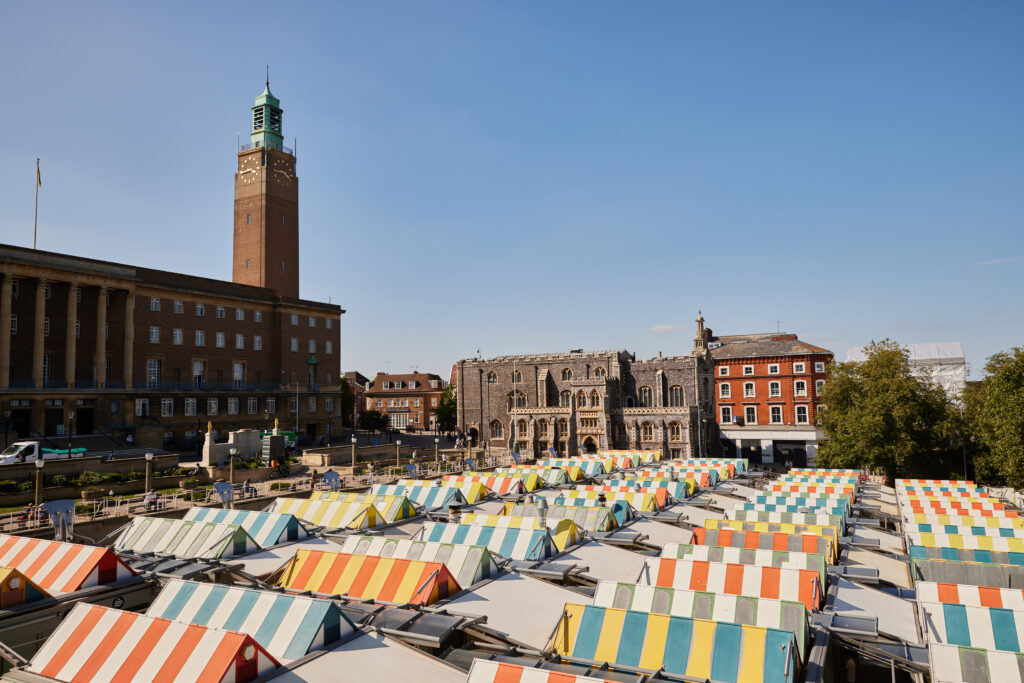
Norwich Market has been on the same site for 900 years- ever since the Normans moved it from its Anglo-Saxon location, Tombland. A hub for trading in the city, it is not much different today. Then, you could buy and sell crops, meat and fish, tools, clothing and luxuries. Today, it’s a go-to for worldwide food stalls, fruit, meat and fish, cheese, flowers, shoe and watch repairs, vintage and more.

The Julian Shrine

The Julian Shrine– also known as St Julian’s- is a Norman round tower church. This is the site of Julian of Norwich’s anchoress cell, where she saw her 16 visions and wrote the book Revelations of Divine Love. She became the first woman to be published in English. As a medieval mystic, people travelled from far away for her advice and today it’s still a site of pilgrimage for followers from across the world.

Alongside these, Norwich is home to a wonderful number of medieval attractions and buildings. Follow our itinerary for a medieval stay in Norwich!

Is Norwich Castle Norman?

Yes, Norwich Castle is a Norman castle.

After the Battle of Hastings, his victory and coronation, William the Conqueror founded Norwich Castle as a Norman royal palace. It was one of 12th-century Europe’s most important buildings.

Initially constructed as a wooden motte and bailey fortress, it was rebuilt in the early 1100s using Caen stone from Normandy. When it was finished, Henry I celebrated Christmas here in 1121.

Today, a visit to Norwich Castle Keep will transport you to its Norman heyday. After a multi-million pound redevelopment, reopening in summer 2025, visitors can experience reinstated Norman floors and authentically produced furniture, ornamentation and textiles.

Inside, see the ‘sequel’ to the Bayeux Tapestry, depicting the feat of Emma de Guader and the origins of Norwich Castle. You can relive this tale with immerse projections every hour in the Keep. As part of the Bayeux Around Britain tour, Norwich Castle will host casts from the original Bayeux Tapestry from 12 November – 10 January 2026.

As the UK’s most accessible castle, you can access every level, including the basement and battlements, which offer panoramic views of Norwich and beyond. There’s a tactile map of the Keep, internal and platform lifts, Changing Places toilet, large print information and captions.

Elsewhere, discover the Gallery of Medieval Life. In partnership with the British Museum- their first outside of London, see almost 1000 medieval artefacts from Norman times and the prosperous years that followed, including armour and coins, religious imagery, everyday objects, jewellery and contemporary inventions.

You can also see original features, including the bases where strong arches once stood, arrowslits and a well.

How did the Normans change Norwich?

After the Battle of Hastings, the Normans soon left their mark on Norwich and Norfolk- most clearly by building impressive and intimidating landmarks.

Across Norfolk, you can see hundreds of Norman round tower churches.

In Norwich, Anglo-Saxon Norvic, its homes and businesses, where demolished for the construction of Norwich Castle and Norwich Cathedral. Where Pull’s Ferry stands today, a canal was dug to transport Caen stone from Normandy up the River Wensum to construct them.

The Anglo-Saxons’ marketplace was in Tombland (meaning empty space). With the construction of Norwich Cathedral, the market was moved to where Norwich Market stands today.

Norwich Castle was founded by William the Conqueror as a wooden motte and bailey castle, before being rebuilt in stone in the early 1100s. Excavations in the 1970s showed that the castle was built over a Saxon cemetery.

Over the following centuries, Norwich became England’s second city, only second to London, and a major trading hub. It boasted the only castle in East Anglia until the mid-1100s.