
Pablo Fanque
Pablo Fanque
by Bruce Lindsay
The next in our Twenty Stories series marking twenty years of VisitNorwich championing the city is about Pablo Fanque– a talented equestrian performer and the first recorded Black circus owner in England who featured in a Beatles song.
Twenty Stories. One City. The City of Stories.
From medieval rebels and mystics to pioneering reformers, artists, entrepreneurs and unsung heroes, these are the people who shaped Norwich over 1000 years- and whose legacy can still be discovered across the city today.
All our stories are told by twenty invited guest authors from across our city’s creative, tourism and cultural community.
Delve into the series and discover the places linked to these incredible people- from museums and tours to cultural landmarks and green spaces. We kindly invite you to- Step Into The Story.
Stories Published So Far:
Jack Valentine | Emma de Guader | Rumsey Wells | John Crome | Harriet Martineau | Julian of Norwich | Elizabeth Fry | Amelia Opie | Margaret Fountaine | Caroline Colman | George Skipper| Samuel Bignold | Anna Sewell | Margaret (Margie) Fahey McGrath | Margaret Paston | Edith Cavell
PABLO FANQUE
1810 – 1871
Pablo Fanque– acrobat, equestrian, and entrepreneur; the first Black circus owner in Britain; the most popular travelling entertainer in the country; and an (unwitting) inspiration for the Beatles. Not bad, for someone who only existed as the alter ego of a poverty-stricken lad from Norwich called William Darby.
The Workhouse Boy
William was born in St Andrew’s Workhouse on 30 March 1810, the second son by that name of the Black, Norwich-born, John Darby and his wife Mary (née Stamp) — the first died in infancy in 1797. Barely into his teens, he was apprenticed to William Batty, an equestrian performer who became one of Britain’s most famous, and wealthiest, circus owners. Thanks to Batty, William Darby grew up to be equally famous, and more loved. But he did so under a new name.
The Performer
William began his performing life as an acrobat. Aged 18 he was billed as ‘Monsieur Darby, the Flying Mercury,’ impressing a Yarmouth journalist with his ‘aerial flights [which] excited a mixture of fear and wonder’. But by the early 1830s he had almost disappeared from the entertainment scene, fading from sight like so many of his fellow artists.
Then he re-invented himself. In 1833 he was ‘Pablo Fanque’, a name suggesting an exotic and glamorous life, far removed from a Norwich workhouse. Within months, Pablo became a star, the ‘loftiest jumper in England’ who could, in a single performance, leap over a garter 12ft. high, through 2 balloons, over 10 horses, through a hoop of real steel daggers—and ‘over A POST CHAISE, LENGTHWAYS!’, all ‘without the assistance of any elastic apparatus’.
The ‘Gentleman of Colour’
Early references to Pablo made many claims regarding his talents, and many other claims regarding his appearance and his origins: the ‘Man of Colour,’ the ‘African Lion Hunter,’ the American, the man from Spain, Portugal, France or India. As Pablo’s fame spread, references to his colour or origins decreased: there was no need to describe this famous entertainer in such stereotypical, sometimes racist, ways.
The Entrepreneur
In 1842 Pablo made another gigantic leap, becoming the first Black British performer to establish his own travelling show. Pablo’s companies travelled widely, drew audiences of thousands from all classes and attracted the patronage of leading figures including Norwich’s own Mayor, Samuel Bignold. Pablo became a master publicist, an innovator in poster design and advertisement copywriting, while his eye for talent ensured he recruited some of the era’s most popular clowns, acrobats, horse riders and performing dogs.
Pablo’s visits to Norwich were few, but his 1848-49 season in the Victoria Gardens with Pablo Fanque Darby’s Circus Royal was a huge success. Pablo was moved to nostalgia, viewing his childhood through rose-tinted spectacles and telling of how he longed ‘To grasp once more the hands of the playmates of his boyhood: to hear once more the music of the rippling brook upon whose banks he has played in childhood’s innocence’. Before he left Norwich he was initiated into the Freemasons, in the Lodge of Perseverance, a sure mark of his acceptance by Victorian society.
There were downsides, too. He borrowed heavily (including from Norwich brewer Richard Bullard), was made bankrupt more than once, was accused of fraud (notably when his Dublin conundrum competition almost caused a riot) and could be violent towards his crew and apprentices, some of whom ran away. He gave to charity, but such philanthropy was expected of circus owners, and he did little more than his competitors. He was found guilty of assault and was the subject of at least one racist attack. Numerous accidents befell his companies: in Leeds his circus auditorium collapsed during a show, killing his wife, Susannah.
The Equestrian
During the 1840s and 1850s, Pablo became Britain’s star equestrian: his skills on horses such as Lady Ayr and Zanthus thrilled the nation. His most loved and most talented horse was Beda, a black-coated mare bought from William Batty.
Pablo and Beda performed together for at least 14 years. They starred at Astley’s Amphitheatre in Westminster during 1847, when a reporter from The Sun wrote that ‘no admirer of horsemanship — no admirer of the ballet — none who can appreciate the acme of grace and elegance, should miss the opportunity of seeing the unique performances of M. Pablo Fanque and his wonderful steed’. In Norwich, Pablo presented Beda in an extravaganza titled The Arab and His Steed.
The Family Man
But how many families? In Norwich, Pablo may have had three children with Maria Banham: one of them, William Darby Banham, performed in Pablo’s companies and became a renowned acrobat in Australia, calling himself ’Pablo Fanque’. Lionel, Pablo’s son with Susannah, followed his father’s path as an entertainer, travelled the world and apparently started the movement ‘to have tea sold without having the weight of the packet included’. Within 3 months of Susannah’s death, Pablo married Elizabeth Corker. They had at least 5 children: George became a musician, Ted became an acrobat, boxer and teller of tales. In the late 1850s Pablo and Elizabeth separated for a time: he lived with Sarah Smith and fathered a daughter, Eliza Smith Darby.
The Unwitting Inspiration
John Lennon would never have written ‘Being for the Benefit of Mr Kite’ had he not found an old poster advertising Pablo Fanque’s Circus Royal’s ‘Grandest Night of the Season … Being for the Benefit of Mr. Kite … and Mr. J Henderson’. Lennon took a few verbatim phrases, made a few alterations and added a spot of poetic licence — a classic song was born and Pablo took his place in popular music history.
The Enigma
Pablo died in Stockport, on 4 May 1871. He was buried in Leeds, next to Susannah, thousands lining the streets to view his funeral procession. On his death, Pablo was found to carry a copy of his brother William’s birth record, rather than his own. No-one knows why. It’s just one of many stories about Pablo Fanque — some of them are true.
Step Into The Story.
A city you don’t just read about – you experience.
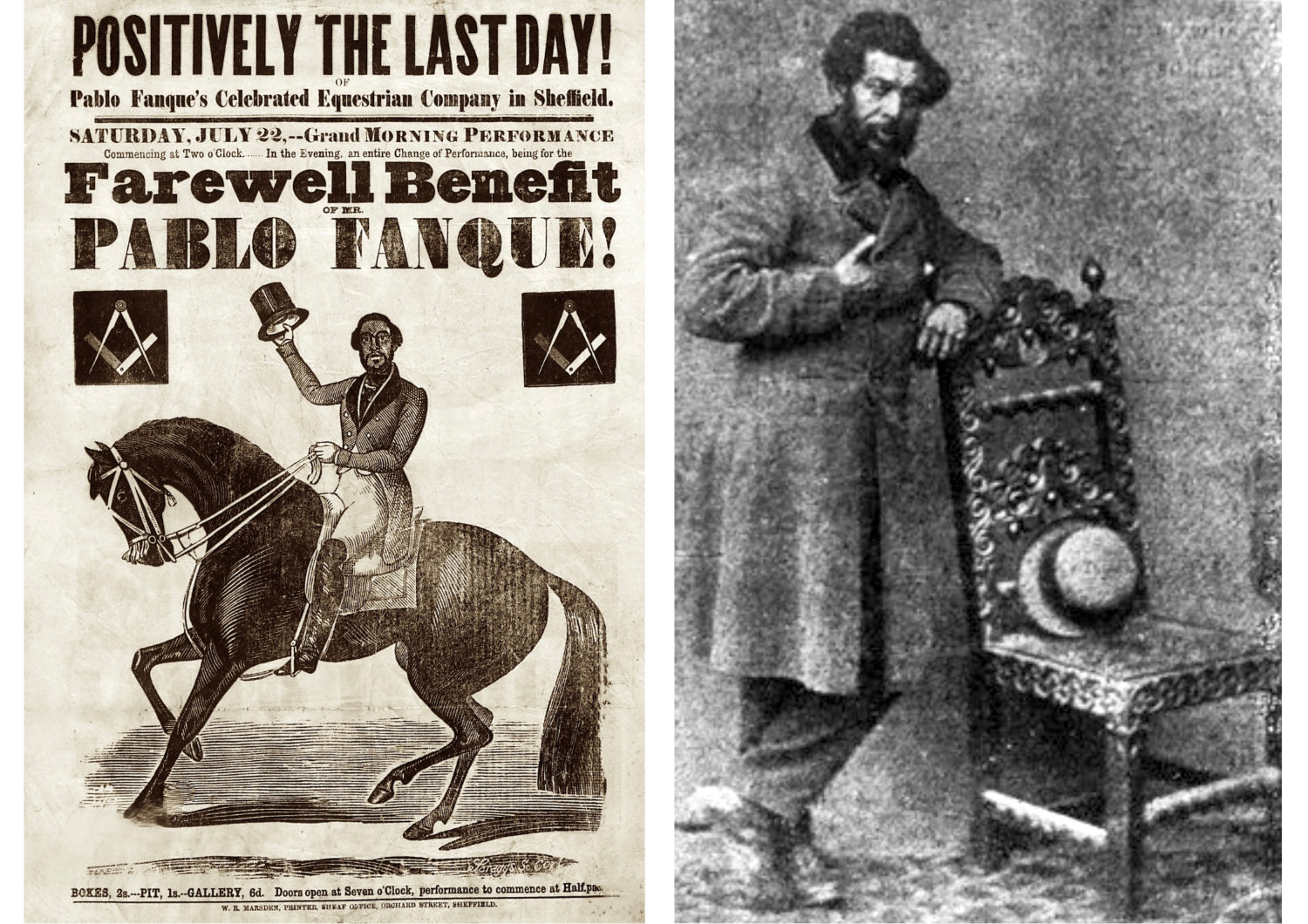
Advertisement for Pablo Fanque’s Circus in Sheffield, 1854; photograph of Pablo Fanque, circa 1860
In Norwich, you’ll find free-to-visit dedications to this pioneering circus proprietor, including a blue plaque on the wall of John Lewis at All Saints Green and a poem by Ira Lightman on the wall of Pablo Fanque House (visible through the glass window from All Saints Green) – read it in the tune of ‘Being for the Benefit of Mr Kite’!
To get to know the city Pablo Fanque knew, we recommend Paul Dickson’s ‘Norwich: A Black History’ tour, which celebrates the diverse contribution of black people to the history of Norwich and Norfolk across two fascinating hours (£9pp).
And if you want to immerse yourself in the wonder of the circus, then Norfolk & Norwich Festival’s headliner Circa, brings their world renowned, daring contemporary circus to the city with Wolf (The Spiegeltent, 13 – 24 May 2026, from £25). That’s followed by the return of Rock N Roll Circus to Earlham Park (20 – 23 August 2026, adults from £66.40). Think international headliners and incredible live circus, as well as the chance to have a go yourself!
Author bio: Bruce Lindsay is a social historian and music journalist. He holds a PhD in history from the University of East Anglia and is an Associate Fellow of the Royal Historical Society. He specialises in the social history of Britain from the late eighteenth century and has written and lectured widely on topics including music, dance, health care, the social history of the gramophone, advertising, and entertainment. His recent books include Dancehalls, Glitterballs and DJs, a history of dance and dance music from 1750 to 1980; Two Bold Singermen, a joint biography of Harry Cox and Sam Larner, the influential Norfolk traditional singers; and Ivor Cutler: A Life Outside the Sitting Room, the biography of the Scottish musician, poet, songwriter, performer and author (all published by Equinox Publishing).
Bruce’s biography of Pablo Fanque, Pablo Fanque’s Fair: the Fabulous Victorian Showman who Inspired the Beatles, is due for publication by Modern Vaudeville Press in early 2027, the 60th anniversary of the Beatles’ Sergeant Pepper’s Lonely Hearts Club Band.
