
Elizabeth Fry
Elizabeth Fry
by Rowan Whiteside
As part of our Twenty Stories series marking twenty years of VisitNorwich championing the city, we’re taking a look at Elizabeth Fry. You might recognise her from the £5 note. A prison reformer and member of the Gurney family who influenced the work of Florence Nightingale. But what about the Quaker woman behind the social reformer?
Twenty Stories. One City. The City of Stories.
From medieval rebels and mystics to pioneering reformers, artists, entrepreneurs and unsung heroes, these are the people who shaped Norwich over 1000 years- and whose legacy can still be discovered across the city today.
All our stories are told by twenty invited guest authors from across our city’s creative, tourism and cultural community.
Delve into the series and discover the places linked to these incredible people- from museums and tours to cultural landmarks and green spaces. We kindly invite you to- Step Into The Story.
Image: Norfolk Museums Service
Stories Published So Far:
Jack Valentine | Emma de Guader | Pablo Fanque | Rumsey Wells | John Crome | Harriet Martineau | Julian of Norwich | Amelia Opie | Margaret Fountaine | Caroline Colman | George Skipper | Samuel Bignold | Anna Sewell | Margaret (Margie) Fahey McGrath | Margaret Paston | Edith Cavell
ELIZABETH FRY
1780 – 1845
The baby is heavy, too hot. Even in the flickering candlelight Betsy can see her crimson cheeks. Teeth maybe, or something brought home by one of her siblings. Or worse, a sickness her mother has carried with her from the slums, brought back in a basket emptied of food and medicines.
Betsy presses her palm to the baby’s forehead. She feels a twist of worry at the warmth. She’s sat here before so many times, praying that it was nothing serious, that it would pass by morning. And so far, she’s been blessed – each baby bouncing back, the red bloom fading to pink, good moods restored, panic over.
She knows that it is good fortune that has kept her children safe. The luck of being born into a wealthy family, of being fed hearty meals, of having a family doctor to check for consumption, the morbid sore throat, the pox. The odds favour them. They are not condemned to a life on the streets, or crawling up chimneys or under machinery
She tightens the shawl around her shoulders. It is a frippery, too fine for the middle of the night, her Norwich shawl. But it’s a piece of home, one that makes her feel held and safe. It’s silky smooth, and she wonders to herself which is softer – her baby’s fluffy hair, freshly grown, or the scarf, woven tight with wool from far away.
The baby coughs, flails, whole body bucking. Betsy holds tight, keeping her safe, not letting her fall in spite of her wriggling. Already Betsy’s head is aching, her eyes sore: she’ll be exhausted tomorrow. Does it make a difference, that she’s awake in the wee hours with the baby? Would the baby fare just as well in the crib?
Except Betsy knows very well she couldn’t leave the baby there alone. Not with her sad cry and spluttering. The nursemaid could watch her, but in spite of being desperate for rest, Betsy believes her presence protects the baby from burning fevers and choking coughs. Besides, she’d never forgive herself if the baby sickened whilst she slept.
Betsy cups the baby’s skull, strokes a finger along the chubby cheeks. If she closes her eyes she can see the prison, the mothers clutching too skinny babies, eyes hopeless. The cells haunt her. She’ll be running through her list: talking to Cook for the week’s meals, making sure the older children are paying attention in lessons, replying to letters, counting candles and coal and calculating if they’ll stretch another week, returning books to the lending library; and then the prison stench catches in the back of her throat.
It sickens her. That other women are preyed upon under the guise of justice, left starving with scant rations of bread, plagued by rats and shivering beneath a worn scrap of blanket. That Betsy knows how appalling their conditions are, and does nothing. Perhaps it is mere vanity to assume that she could change things. To think if she wasn’t preoccupied with her children, her husband, the perilous position of their income, that she might be able to improve conditions in prisons, encourage mercy rather than judgement.
The baby’s breathing speeds, wheezes, and Betsy’s heartbeat races in response. She strips the blanket off, in spite of the chill of the air, places cool hands on the back of the baby’s neck, whispers, ‘oh dear sweet one, you poor little lamb’. She touches her cheek to the baby’s, breathes deeply as if she could inhale the sickness and take it in herself, leaving the baby bonny and whole.
She would give her life for her children, and yet she feels a quiet desperation at her existence slipping away in increments, each moment filled with urgency but no greater purpose. And the children keep coming: somehow a surprise each time, although she herself is one of many. She is the oldest—witness to her siblings born, transform into squalling babies, unsteady toddlers, grubby-faced children—of those who survived, at least. She knows she is ungrateful, to wish for something bigger, when she should be counting her blessings that her children are hale and whole.
Betsy has always felt the calling: to put faith above fripperies, to choose God before luxuries. She chose to be a strict Friend, wear plain clothes in spite of the teasing from her sisters, started her Sunday school even though the children caused mischief at Earlham Hall. She is sure she is meant to change things, sure that God has promised her to make a difference.
She is sure she is meant to be more than ‘mother’, but she knows she would sacrifice everything to keep her children safe. Betsy stares into the fire and imagines how she could campaign for better to change lives and ensure that no mother watches their children wanting for food, shelter, warmth. Yet, if some demon appeared to her and said you can save thousands of children at the cost of your baby, she would curse it to hell. She wants both.
The baby snuffles in her arms. The dark is fading to grey, the shadowed shapes of furniture becoming solid. They have almost made it through the night, the minutes lasting forever, the hours vanishing in short breaths. Soon the day will start, and Betsy will be a mother to many again, the mistress to a household, and her dreams will have to wait.
Step Into The Story.
A city you don’t just read about – you experience.
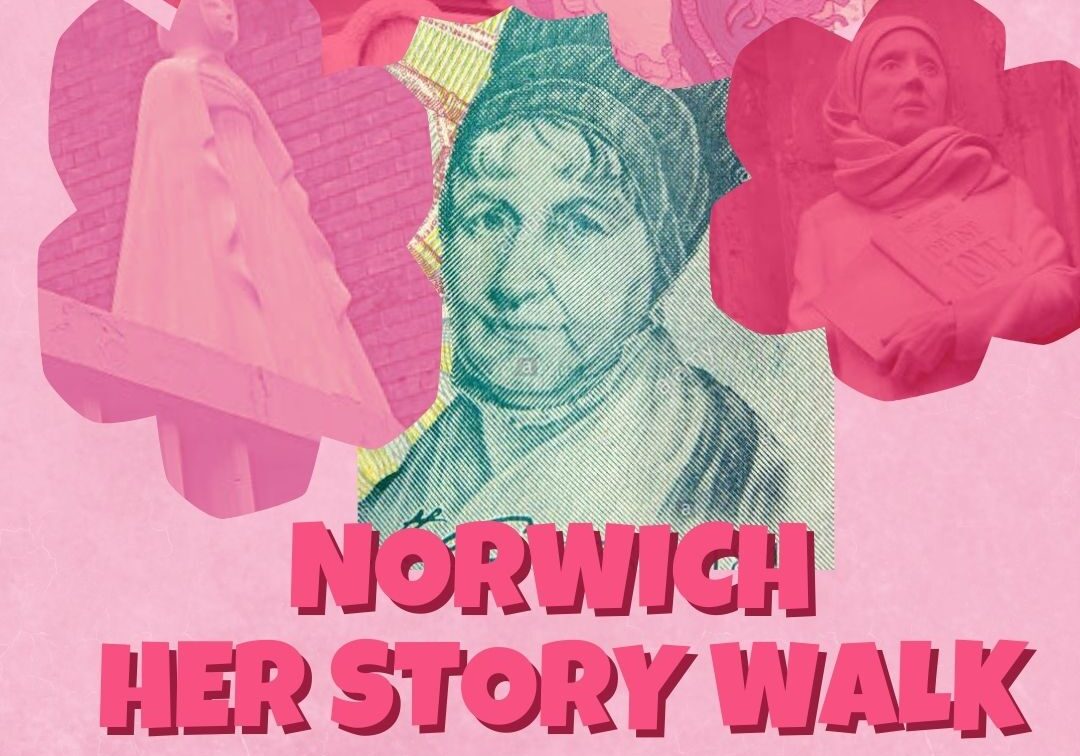
Join one of Norwich Story Walk’s fascinating Her Story Walks to hear more about Elizabeth Fry (pictured here)
Prison reformer Elizabeth Fry is probably one of the most famous women Quakers- a pioneering woman and mother of 11 children whose work led to reforms across the world. In 1818, she became the first woman to give evidence to a committee of the House of Commons on London prisons. Her work saw better conditions for prisoners, including men and women segregated, a school for the children of prisoners, and clothes and warm supplies provided.
She also led changes for women prisoners travelling to the colonies, supplying them each with a bag for making patchwork quilts which could be sold on arrival to provide an income. Chances are you’ll recognise her from the former £5 note (in circulation from 2002 – 2016).
You can hear about Elizabeth Fry and other remarkable women on a a fascinating Her Story Walk with Norwich Story Walks (£10pp). And why not head to Gurney Court- just off Magdalen Street- to see the plaque in Elizabeth Fry’s honour? Here, she was born and lived in Gurney House.
Author bio: Rowan Whiteside was born in South Africa, but has spent most of her life in Norwich. She works in arts and culture marketing, and has a Masters in Creative Writing (Prose) from the University of East Anglia. rowanwhiteside.co.uk
