
Rumsey Wells
Rumsey Wells
by Stacia Briggs
Rumsey Wells: the next in our Twenty Stories series marking twenty years of VisitNorwich championing the city. One half of successful Norwich hat making business, T. Wells & Son, he recognised the art of storytelling ahead of his time.
Twenty Stories. One City. The City of Stories.
From medieval rebels and mystics to pioneering reformers, artists, entrepreneurs and unsung heroes, these are the people who shaped Norwich over 1000 years- and whose legacy can still be discovered across the city today.
All our stories are told by twenty invited guest authors from across our city’s creative, tourism and cultural community.
Delve into the series and discover the places linked to these incredible people- from museums and tours to cultural landmarks and green spaces. We kindly invite you to- Step Into The Story.
Stories Published So Far:
Jack Valentine | Emma de Guader | Pablo Fanque | John Crome | Harriet Martineau | Julian of Norwich | Elizabeth Fry | Amelia Opie | Margaret Fountaine | Caroline Colman | George Skipper | Samuel Bignold | Anna Sewell | Margaret (Margie) Fahey McGrath | Margaret Paston | Edith Cavell
RUMSEY WELLS
1877 – 1937
Norwich is a City of Stories: not the quiet kind that sits politely on shelves, but the sort that strides out into the street, tips their hat and insists on being noticed.
Herbert Rumsey Wells would have approved of that.
Because if you had stepped into his shop on St Andrews Street, you would have known immediately that he was not simply selling caps. He was selling a feeling.
Mr Wells would have been impeccably dressed, of course, because one cannot very well sell transformation while looking even slightly unfinished.
His whiskers were intentional not incidental, his coat carried just enough drama to suggest theatre, his hat was so well behaved it might have bowed before you did.
And then, before you could even think to ask about prices, he would have begun to tell you a story…not about the hat, about you. Or rather the person you might become once you put it on.
Rumsey knew, long before marketing departments found the language for it, that people do not buy products. They buy identities, invitations, a version of themselves that feels just slightly more interesting than the one they woke up with.
And in truth, the theatre of the man was not imagined.
When he died in 1937, he was remembered as “a picturesque personality”, known to thousands by his ‘Doggie’ cap, his large Inverness cape, his snuffbox and, on occasion, a monocle. He travelled from Land’s End to John O’Groats, quite literally becoming his own walking advertisement.
Which tells you everything, really, because Rumsey Wells did not just understand storytelling, he inhabited it.
The firm of Wells and Son had been established in 1815, outfitting clubs, regiments and schools from Cockey Lane, now London Street, in an era when men wore towering beaver hats for pursuits that must have looked faintly absurd beneath them.
Golf in a top hat. Fishing in a top hat. One hopes the trout took some comfort in the elegance of it all.
Rumsey Wells, born in 1877, entered a world that was beginning to move faster, think differently and loosen its collar.
By the time he became a partner in 1904, at premises on St Andrews Street, he could see what was coming.
So, he gave the future something extraordinary to wear: not just any cap, but caps for living in.
Sporting caps for hunting, bicycling, boating and travelling. Caps that moved with a man rather than merely sitting upon him, a welcome change from the rigid formality of what had come before.
As the motor car arrived, so did his flat, circular-topped designs with padded linings, practical, modern and quietly revolutionary.
Among them were his famous ‘Doggie’ caps, finished with a distinctive stitched edge so they could be lifted with a certain flourish, like a bowler hat tipped in acknowledgement of applause. They were not only well made, they were thoughtfully made.
Rumsey understood that detail is where loyalty lives.
And then, with a confidence that feels startlingly modern, he did something rather magnificent: he told the world his caps were the most expensive you could buy.
Long before anyone thought to reassure us about expensive lager, Rumsey Wells was already there, cheerfully insisting that expense was not a problem to overcome but a pleasure to embrace.
It was bold, it was cheeky, it was, frankly, brilliant.
Because in doing so, he transformed price into prestige and purchase into participation. To wear a Wells cap was not merely to own something fine, it was to signal that you understood something others perhaps did not.
And he didn’t stop there.
Rumsey was an ingenious and indefatigable self-publicist, producing pamphlets and booklets that wove together the virtues of his caps with the story of Norwich itself, its silk, its craft, its character. You did not read them so much as step into them.
One favourite tells of a gentleman arriving alone in Cairo. Spotting another man in a Wells cap across the street, he marched over, clapped him on the back and declared that any man wearing such a cap must surely be worth knowing and, more importantly, worth sharing a drink with.
There it is, perfectly formed: a hat as a handshake, a brand as a bridge between strangers.
Rumsey had no algorithms, no analytics, no carefully scheduled campaigns. What he had was instinct, humour and a deep understanding that a good story travels further than any advertisement ever could.
He kept customers’ measurements for years, sometimes decades.
One man returning to Norwich after a long absence was astonished to find his schoolboy measurements still on file, ready to be called back into service.
There is something quietly profound in that, to be remembered so precisely, to be welcomed back so easily.
Even his hat names carried stories, drawn from Norfolk itself. Brancaster. Blofield. Westwick. Conesford. Each cap a small geography of belonging, each one carrying a piece of the county out into the wider world.
This is where Rumsey feels closest to us now.
Because those of us who spend our lives shaping words, experiences and invitations are still circling the same truth he grasped instinctively: that storytelling is not decoration, it is the thing itself.
As a journalist, and now as a marketer, I recognise the craft. Not in the tools, which have changed beyond recognition, but in the intention. To take something real and present it in such a way that someone pauses, smiles and steps closer.
Rumsey did that with felt and thread, we do it with words and moments. But the aim is the same: to make something feel worth belonging to.
So next time you find yourself on St Andrews Street, pause for a moment. Consider the man who stood there, turning caps into conversation and customers into co-conspirators.
Better still, step inside. Raise a glass. Tip an imaginary brim.
And remember that Norwich is full of stories like this, waiting patiently, confidently, for someone to notice them. All you have to do is step into the story.
Step Into The Story.
A city you don’t just read about – you experience.
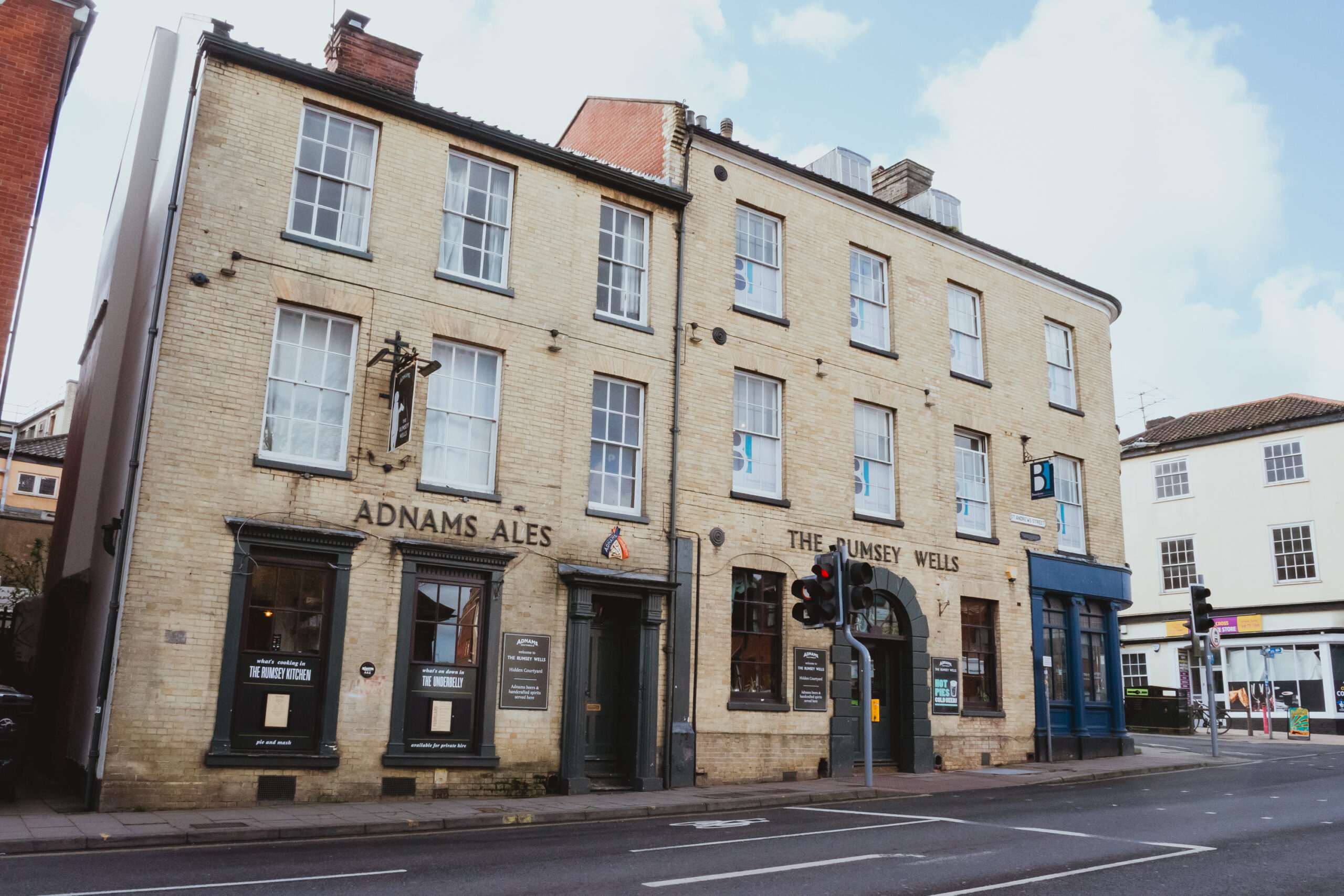
Sit for a moment in The Rumsey Wells- a place where stories were once stitched as carefully as the caps themselves.
To meet Herbert Rumsey Wells today, you only need to know where to look.
The Museum of Norwich holds a beautifully curated glimpse into his world, with an exhibition case dedicated to the man who turned caps into conversation and commerce into theatre. There’s even a box of hats like those Wells designed for you to try on- see which style you suit best!
And if you follow his footsteps to St Andrews Street, you will find yourself exactly where his shop once stood. Only now, instead of measuring heads and dispatching hats across the globe, the building offers something equally convivial.
Step inside The Rumsey Wells for a pint, a G&T, or something to eat and sit for a moment in a place where stories were once stitched as carefully as the caps themselves. How about their unique cocktail The Herbert? Named for Rumsey Wells himself, it’s a refreshing blend of dark rum, hot honey, lime and ginger beer.
Because Norwich is not a city you simply read about, it’s a city you experience.
And somewhere between the museum case and the clink of a glass, you may find that Rumsey Wells is still doing what he always did best.
Author bio: Trained at BBC Radio Norfolk, Stacia went on to become Chief Reporter and later Chief Writer at the Eastern Daily Press, where she spent 30 years and won more than 10 national and regional writing awards. She is one half of the Norfolk Folklore Society alongside co-creator Siofra Connor, creating podcasts and live events that tell stories shaped by local magic and memory. As Director of The Assembly House in Norwich, a Georgian mansion known for its hospitality, celebrations and imaginative dining experiences, she leads creative design, branding and marketing. At heart, she is a storyteller, an enthusiastic edible glitter user and a committed insomniac.
