
Amelia Opie
Amelia Opie
by Siv Sears
Author and abolitionist. Philanthropist and feminist. There is more to Amelia Opie than first meets the eye. Here, we learn about her as part of our Twenty Stories series marking twenty years of VisitNorwich championing the city.
Twenty Stories. One City. The City of Stories.
From medieval rebels and mystics to pioneering reformers, artists, entrepreneurs and unsung heroes, these are the people who shaped Norwich over 1000 years- and whose legacy can still be discovered across the city today.
All our stories are told by twenty invited guest authors from across our city’s creative, tourism and cultural community.
Delve into the series and discover the places linked to these incredible people- from museums and tours to cultural landmarks and green spaces. We kindly invite you to- Step Into The Story.
Stories Published So Far:
Jack Valentine | Emma de Guader | Pablo Fanque | Rumsey Wells | John Crome | Harriet Martineau | Julian of Norwich | Elizabeth Fry | Margaret Fountaine | Caroline Colman | George Skipper | Samuel Bignold | Anna Sewell | Margaret (Margie) Fahey McGrath | Margaret Paston | Edith Cavell | Sir Thomas Browne | Peter the Wild Boy
AMELIA OPIE
1769 – 1853
Amelia Opie: Norwich’s Radical Pen
Look up as you walk along Opie Street. High above the doorway of Café Gelato, a statue of Amelia Opie gazes out across the city that shaped her. Today she is remembered as a philanthropist and anti-slavery campaigner. But she first made her name in a very different way: by writing some of the most daring and controversial fiction of her age.
Born Amelia Alderson in 1769 in Colegate, she grew up in a Norwich alive with new ideas. Her parents were members of the non-conformist Unitarian Church based out of The Octagon Chapel, a centre of intellectual and religious debate, and their home welcomed artists, reformers and thinkers. From an early age, Amelia absorbed the belief that ideas mattered and that society could be improved.
The Writer
Long before she became an activist, Amelia Opie was one of Britain’s bestselling authors. Her first novel, The Dangers of Coquetry, written when she was barely out of her teens, explored the destructive consequences of flirtation and social manipulation. It was an early sign that she was willing to tackle subjects many writers avoided.
After marrying the celebrated artist John Opie in 1798 and moving to London, she entered radical literary circles that included Mary Wollstonecraft and William Godwin. Their influence can be seen in her most famous novel, Adeline Mowbray (1804), a work that pushed against the boundaries of acceptable fiction.
At a time when women were expected to marry respectably and remain within strict social rules, Opie wrote about female independence, relationships outside marriage and the consequences of defying convention. She explored moral ambiguity rather than offering easy answers. Other works addressed topics including interracial marriage, social inequality and the limits placed on women’s lives. Her fiction was popular, but it was also provocative.
Opie was fascinated by the political upheavals transforming Europe. In 1802, she and her husband travelled to France during the brief Peace of Amiens. Like many reform-minded Britons, they wanted to see for themselves what society looked like after revolution. The old order had fallen, new ideas were being tested and the future remained uncertain. For Amelia, the journey was an opportunity to witness history in the making and to reflect on how societies change.
By the early nineteenth century, she had become one of Britain’s most respected novelists. Yet another chapter of her life was about to begin.
The Activist
The death of John Opie in 1807 eventually drew Amelia back to Norwich. From her home on what is now named “Opie Street” (after her), she became increasingly devoted to philanthropy and reform. The concerns she had explored in fiction became causes she pursued in real life.
She visited hospitals, prisons, workhouses and poor families across the city. In 1825, she joined the Religious Society of Friends, adopting the plain dress and practical values of the Quakers. The figure looking down from the statue on Opie Street today is dressed in that later Quaker style.
Her greatest cause was the abolition of slavery. Working with fellow reformers, including Anna Gurney, she helped mobilise support across Norwich and Norfolk. She attended meetings, organised petitions and used her fame to bring attention to the movement. In 1833, campaigners presented Parliament with a vast anti-slavery petition signed by 187,000 women, one of the largest such campaigns of its day.
Amelia remained active well into old age. She travelled, campaigned and corresponded with reformers across Britain. The same determination that had made her a pioneering novelist now fuelled her activism.
When she died in 1853, Norwich lost one of its most remarkable citizens. Yet traces of her remain throughout the city: in Colegate, where her story began; at the Octagon Chapel that helped shape her thinking; and on Opie Street, where her statue still watches over passers-by.
Amelia Opie spent her life asking difficult questions – about freedom, justice, equality and how people should live together. First through her novels and then through her activism, she challenged her contemporaries to imagine a better society. Norwich is still telling her story.
Step Into The Story.
A city you don’t just read about – you experience.
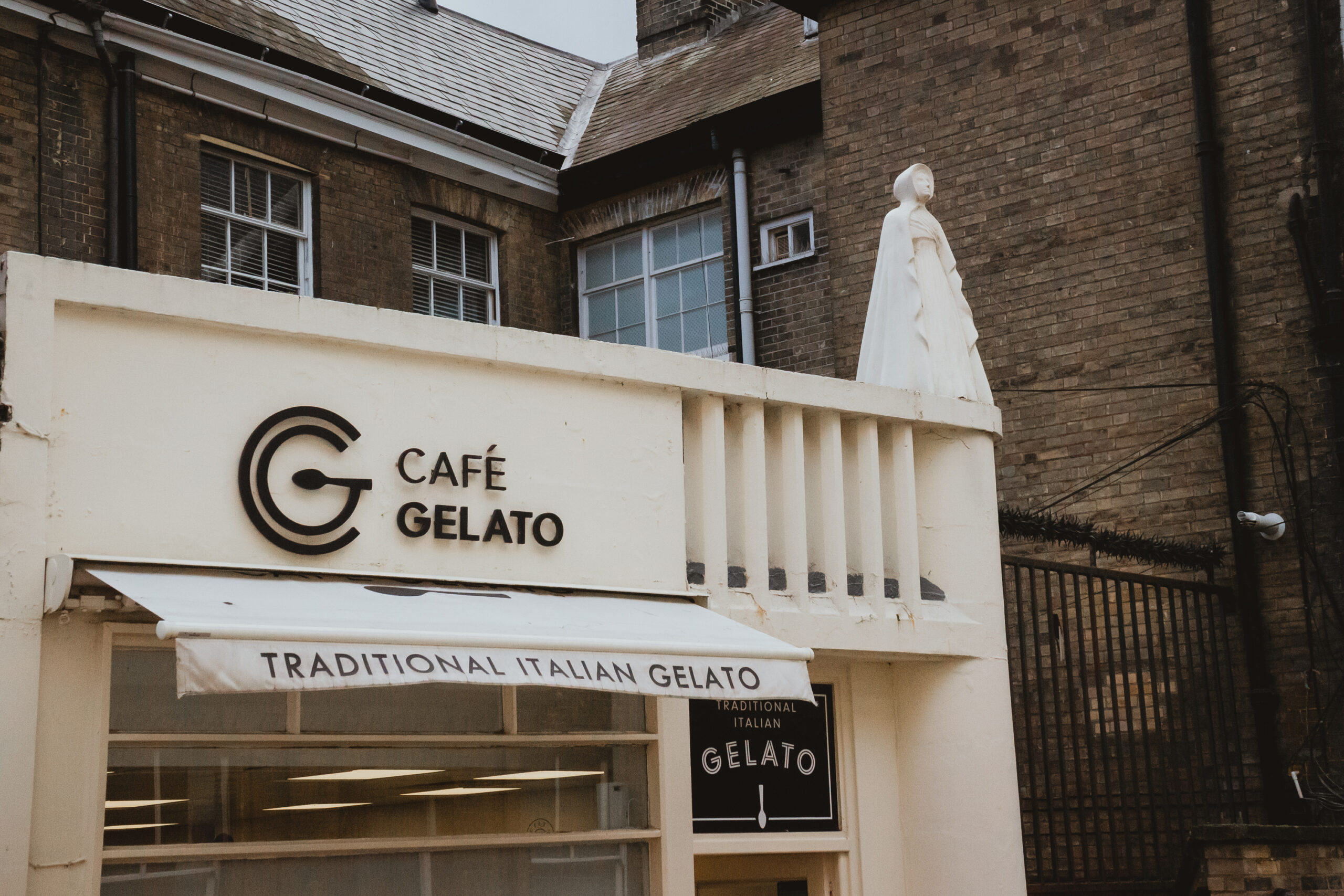
Stop by Cafe Gelato for a scoop of ice cream underneath the gaze of Opie’s statue
On Norwich Story Walks’ fascinating Her Story Walk (£10pp, private tours available), you can hear all about Amelia and other important women of Norwich, including many of the names in our ‘Twenty Stories. One City’ series.
And when you’re exploring the Norwich Lanes, make sure to pay a visit to Opie Street. See if you can spot the statue of Amelia Opie on the roof of Café Gelato– we highly recommend treating yourself to a scoop or two as a reward. (It’s a favourite too of Emma Thompson!)
Author bio: Siv Sears is an educator, entertainer, and founder of Norwich Story Walks, which offers alternative and engaging guided tours of the city. Through a blend of storytelling, performance, and historical insight, Siv brings Norwich’s past to life in fresh and accessible ways. Their work includes the Norwich Her Story Walk – featuring Amelia Opie – a tour dedicated to uncovering and celebrating the lives of women connected to the city, inviting participants to see Norwich through new and thought‑provoking perspectives.
