
Margaret Fountaine
Margaret Fountaine
by Jo Warr
The next in our Twenty Stories series marking twenty years of VisitNorwich championing the city is about Margaret Fountaine– lepidopterist and prolific diarist, who donated her magnificent Fountaine-Neimy collection of butterflies to Norwich Castle Museum & Art Gallery (you can see behind the scenes with Norfolk Museums Service’s Senior Curator of Climate Change and the Dynamic Coast Leanne Melbourne) .
Twenty Stories. One City. The City of Stories.
From medieval rebels and mystics to pioneering reformers, artists, entrepreneurs and unsung heroes, these are the people who shaped Norwich over 1000 years- and whose legacy can still be discovered across the city today.
All our stories are told by twenty invited guest authors from across our city’s creative, tourism and cultural community.
Delve into the series with our NEW, FREE, mobile-friendly trail and discover the places linked to these incredible people- from museums and tours to cultural landmarks and green spaces. We kindly invite you to- Step Into The Story.
Stories Published So Far:
Jack Valentine | Emma de Guader | Pablo Fanque | Rumsey Wells | John Crome | Harriet Martineau | Julian of Norwich | Amelia Opie | Caroline Colman | George Skipper | Samuel Bignold | Anna Sewell | Margaret (Margie) Fahey McGrath | Margaret Paston
MARGARET FOUNTAINE
1862 – 1940
In the museum collections of Norwich Castle, rests the most remarkable butterfly collection of 22,000 specimens gathered over nearly 50 years. More remarkable still is the story of the woman who assembled the collection: Margaret Fountaine. Defying the expectations of women of her era, she became one of the most widely travelled naturalists of her generation.
Margaret was born in the Norfolk village of South Acre in 1862, the daughter of a clergyman. She spent much of her childhood outdoors in a landscape rich with wildlife which fostered her love for the natural world, but when her father died in 1877 the family moved to Upton Road in Norwich.
At the age of 16, Margaret began keeping a diary, a habit she maintained for the rest of her life. She eventually filled 12 leather-bound volumes, which were sealed in a black tin trunk, with instructions that it should not be opened until 15 April 1978, exactly a century after her first diary entry- so for nearly 40 years it remained untouched. When it was finally unsealed, the diaries revealed her extraordinary life with startling candour, but in drawing attention to her romances, the contents somewhat overshadowed her scientific achievements.
In her twenties, she came into an inheritance from an uncle, which gave her the financial independence to travel. She went first to France and Switzerland where her fascination with butterflies took hold of her completely and Lepidopterology, the scientific study of butterflies, became her vocation. Largely self-taught, she mastered classification, learned to breed caterpillars and documented life cycles.
Over the next 50 years, Margaret travelled to more than 60 countries in pursuit of specimens, often venturing alone, or with only a guide, into remote regions. She collected across Europe, the Middle East, Asia, Africa, South America and the Caribbean. She published research articles in leading scientific journals, was elected to the Entomological Society of London in 1898, and to the Linnean Society in 1912, becoming recognised as a serious lepidopterist.
And she was doing it in a field that was almost entirely dominated by men. When she became a Fellow of the Entomological Society, she was often the only woman in the room. There was hardly any career path mapped out for women in science, no institutional support, no obvious models to follow. Fountaine forged her own path entirely, building her authority through the sheer breadth and quality of her collection, gathered from across the globe.
Perhaps the most striking aspect of Margaret’s work is that she bred and released far more butterflies than she ever pinned. When rearing broods from eggs or caterpillars, she would keep only one or two perfect specimens for her cabinets, then release hundreds more back into the wild. This was an early form of conservation breeding, decades before such practices became mainstream.
In 1901, while in Syria, she hired a local guide and interpreter named Khalil Neimy. He was fifteen years her junior and married. Their professional relationship deepened over time and Khalil became the great love of her life. For the next 27 years, they travelled the world together until his death. The collection she eventually bequeathed to Norwich Castle bears both their names, at her insistence, to honour their collecting partnership: The Fountaine-Neimy Collection.
Throughout their travels together, she continued to collect, document and publish, recording many species that had never been described before. The collection she amassed remains one of the great achievements of British natural sciences, though you would not always know it from how history has treated her.
Margaret considered donating her collection to the Natural History Museum, but they intended to disperse her specimens amongst their existing collections. She wanted her butterflies to stay together, housed in the mahogany cabinets she had commissioned, and so, on her death, her collection was bequeathed to Norwich Castle to keep her life’s work intact just as she wanted.
It would be easy to reduce Margaret Fountaine’s story to the eccentric Victorian butterfly lady with the scandalous diary, but to do so would repeat a mistake made too often in her lifetime. She was, above all, an accomplished lepidopterist who contributed meaningfully to our understanding of the natural world, and whose collection is still used today as a reference point to inform new scientific research.
Norwich has always had a streak of cheerful defiance running through it. The city’s history is full of stories of pioneering women who refused the roles assigned to them and Margaret, gloriously independent, was one of them. In the City of Stories, few stories are quite as colourful as hers.
Today, the Fountaine-Neimy Collection remains a highlight of Norwich Castle’s Natural History department and, fittingly, Margaret’s specimens and journals are now cared for by Dr Leanne Melbourne: the Castle’s first ever female Natural History curator.
Step Into The Story.
A city you don’t just read about – you experience.
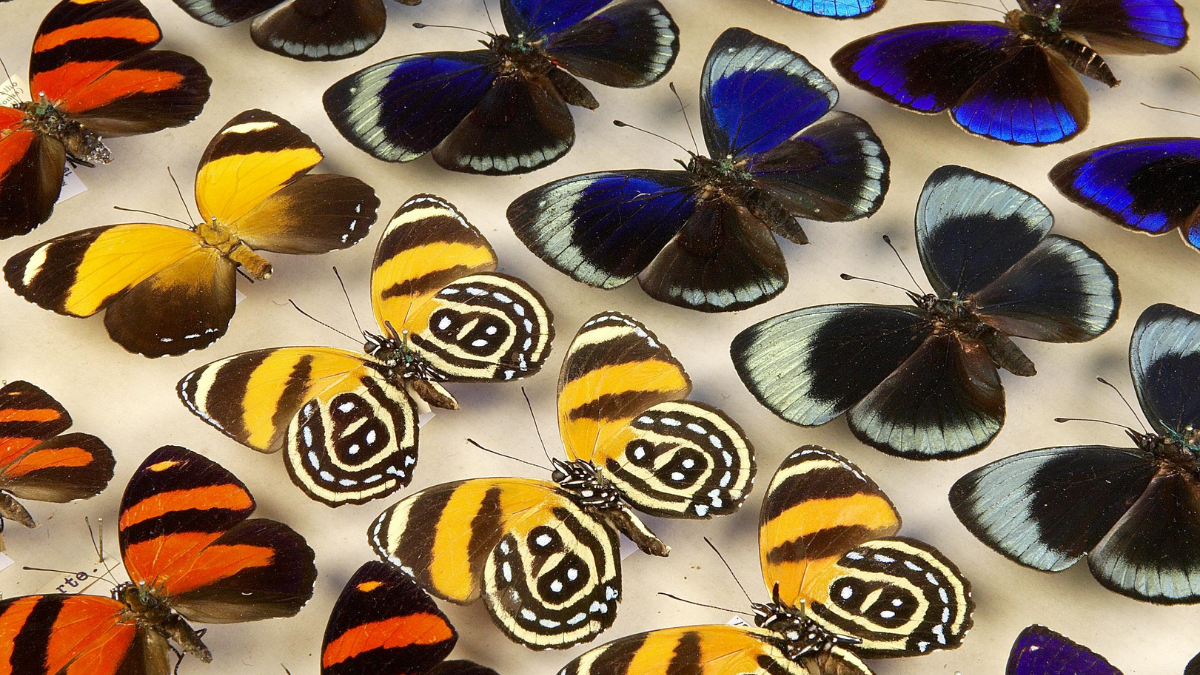
Norwich Castle’s Fountaine-Neimy collection of butterflies is incredible striking- marvel at these specimens in their Natural History galleries
You can admire the Fountaine-Neimy collection of butterflies in the Natural History Galleries at Norwich Castle Museum & Art Gallery. Take a look at the kaleidoscopic drawer of perfectly preserved specimens.
And to experience wonder akin to Margaret’s own, head to The Bug Parc in Lenwade (11 miles from Norwich, Wednesday – Sunday and bank holidays, adults from £13.95, children from £11.95) to experience their amazing tropical Butterfly House (and other tropical houses, including bug handling). The large butterfly dome spans 2,700sq ft, a Koi pond and goldfish pond and is home to over 400 beautiful butterflies (and 30 different species) flitting past.
There are also plenty of opportunities to spot butterflies across Norfolk– but none more so than Pensthorpe nature reserve (23 miles from Norwich, Monday – Sunday, from £10.95) where there are 700 acres of natural grounds with gardens, play areas, and stunning wildlife. This is a fantastic day out.
Author bio: Jo Warr is a Norwich native who has spent her career working in the arts and heritage sectors. As Head of Development at Norfolk Museums Service, she contributes to the leadership of one of the UK’s largest county museum services, which includes ten museums. Based at Norwich Castle, she is responsible for fundraising, marketing and communications, programming, and partnerships. She is motivated by the role museums play in connecting people to Norfolk’s history and bringing its stories to wider audiences.
