
Samuel Bignold
Samuel Bignold
by Katie Thompson
Dubbed the ‘Father of the City’, this story in our Twenty Stories series marking twenty years of VisitNorwich championing the city is about Samuel Bignold. Not only secretary of Norwich Union for 60 years, he was a true champion of the city and considered ‘saviour’ of Norwich Castle.
Twenty Stories. One City. The City of Stories.
From medieval rebels and mystics to pioneering reformers, artists, entrepreneurs and unsung heroes, these are the people who shaped Norwich over 1000 years- and whose legacy can still be discovered across the city today.
All our stories are told by twenty invited guest authors from across our city’s creative, tourism and cultural community.
Delve into the series with our NEW, FREE, mobile-friendly trail and discover the places linked to these incredible people- from museums and tours to cultural landmarks and green spaces. We kindly invite you to- Step Into The Story.
Stories Published So Far:
Jack Valentine | Emma de Guader | Pablo Fanque | Rumsey Wells | John Crome | Harriet Martineau | Julian of Norwich | Amelia Opie | Margaret Fountaine | Caroline Colman | George Skipper | Anna Sewell | Margaret (Margie) Fahey McGrath | Margaret Paston
SAMUEL BIGNOLD
1791 – 1875
Samuel Bignold. A man who 150 years ago would’ve needed no introduction.
The third son of Norwich Union (now Aviva) founder Thomas, Samuel succeeded his father as secretary in 1818, running the business for almost 60 years until his death in 1875. Mayor of Norwich, he was elected four times (1833, 1848, 1853 and 1872, if you’re counting). Adding to these accolades, Samuel Bignold was Sheriff of Norwich in 1830, knighted by Queen Victoria in 1854 and MP for Norwich from 1854 – 1857. He was a supporter of the arts- Norwich School of Artists in particular, a man of firsts and the so-called ‘saviour’ of Norwich Castle.
And so, it comes as no surprise Samuel Bignold was dubbed ‘Father of the City’.
Did you know that Norwich Castle wouldn’t be the iconic sight we see today without Bignold’s intervention?
In his first term as Mayor, this landmark had seen hundreds of years as the county gaol, overcrowded and unhygienic. It resulted in two successive refurbishments (within just 20 years of each other)- ones that met the conditions set by Norwich’s own prison reformer Elizabeth Fry. So, with a shiny new prison inside, the castle walls looked more dilapidated than ever.
The solution? Rebuild the walls, of course! Specifically, the south and west walls.
As any proud Norwich citizen would expect, this didn’t go down so well. In the face of “demolition”, Samuel Bignold passed a resolution to restore the walls to their former glory, bringing in an antiquary and architect to preserve the castle’s Norman design, this time with Bath stone (cheaper than Caen stone). Although this move wasn’t uncontroversial, Norwich Castle remains sympathetic to its original design, watching over the city.
This is just one example of Samuel Bignold’s respect and love for the arts, culture and heritage (he was also a big supporter of The Norwich Music Festival, the predecessor to Norfolk & Norwich Festival and a good friend of author and activist Amelia Opie!), something still ingrained into the spirit of Norwich.
Today, Norwich Castle is home to the world’s largest collection of works by the Norwich School of Artists. Chances are this has a lot to do with Samuel Bignold (one of the exhibition galleries is named after Norwich Union, after all).
Many of the school’s members were frequent visitors to his home and co-founder Robert Ladbrooke taught drawing to his children. It’s said that their works adorned the walls of Bignold House (on Surrey Street, opposite Aviva).
Alongside names like John Crome and Joseph Stannard, John Sell Cotman was a leading landscape and marine painter- not to mention a favourite of Bignold. So much so, that Cotman was recommended by Samuel (and J.M.W Turner) to King’s College to become their Master of Landscape Drawing. One of his students was poet Dante Gabriel Rossetti.
As we’ve already seen, this was a time where arts and industry blossomed in England. Figures like Samuel Bignold were integral to progression and creating a more equal community.
As well as being a father to six boys and seven girls, Samuel found time to watch over Norwich Union Fire and Life Offices for six decades, ensuring its head offices stayed put in Norwich and not London, and set up the Norfolk Yarn Company in 1836, where he laid the first stone of its new factory (you can see a plaque on St James’ Mill).
In 1848, Samuel rode the first East Union Railway train joining Norwich to London (via Stratford, Colchester and Ipswich- sound familiar?), it’s construction he’d promoted over 10 years earlier. In the 1850s, he helped bring Jenny Lind to the city and the construction of the Jenny Lind Children’s Hospital (of which he was president), before laying the foundation stone of the UK’s first Free Library.
And this is all without mentioning his legacy at Norwich Union and as a prominent figure in politics- but they’re stories for another time.
There can be no doubt how important Samuel Bignold’s presence was in our fine city. For starters, his portrait hung in St Andrews Hall for almost 160 years. Known for his fluency, kindness and genuine love for Norwich and Norfolk, the whole city celebrated his 83rd birthday- schools were granted a holiday and the workhouses were given a feast- less than three months before his death.
Samuel Bignold was “a friend” of Norwich, whom not a household did not mourn. A “thoughtful and considerate” man, whose “charity knew no bounds” and was “read to bear a citizen’s path” (Norfolk Herald, 18 January 1875).
You could even say that Samuel Bignold was the blueprint for many a Norwich native today. Unafraid to shout about our creatives and makers, with a love for heritage, arts and the city we live in.
Whilst buried in St Mary’s church in Old Catton, Samuel Bignold’s name is etched onto the monument in honour of his wife Elizabeth in St Stephen’s church. And if you’re out and about, you can see Samuel standing proudly outside Norwich Union’s home of Surrey House (hint: he’s the statue of the right).
Step Into The Story.
A city you don’t just read about – you experience.
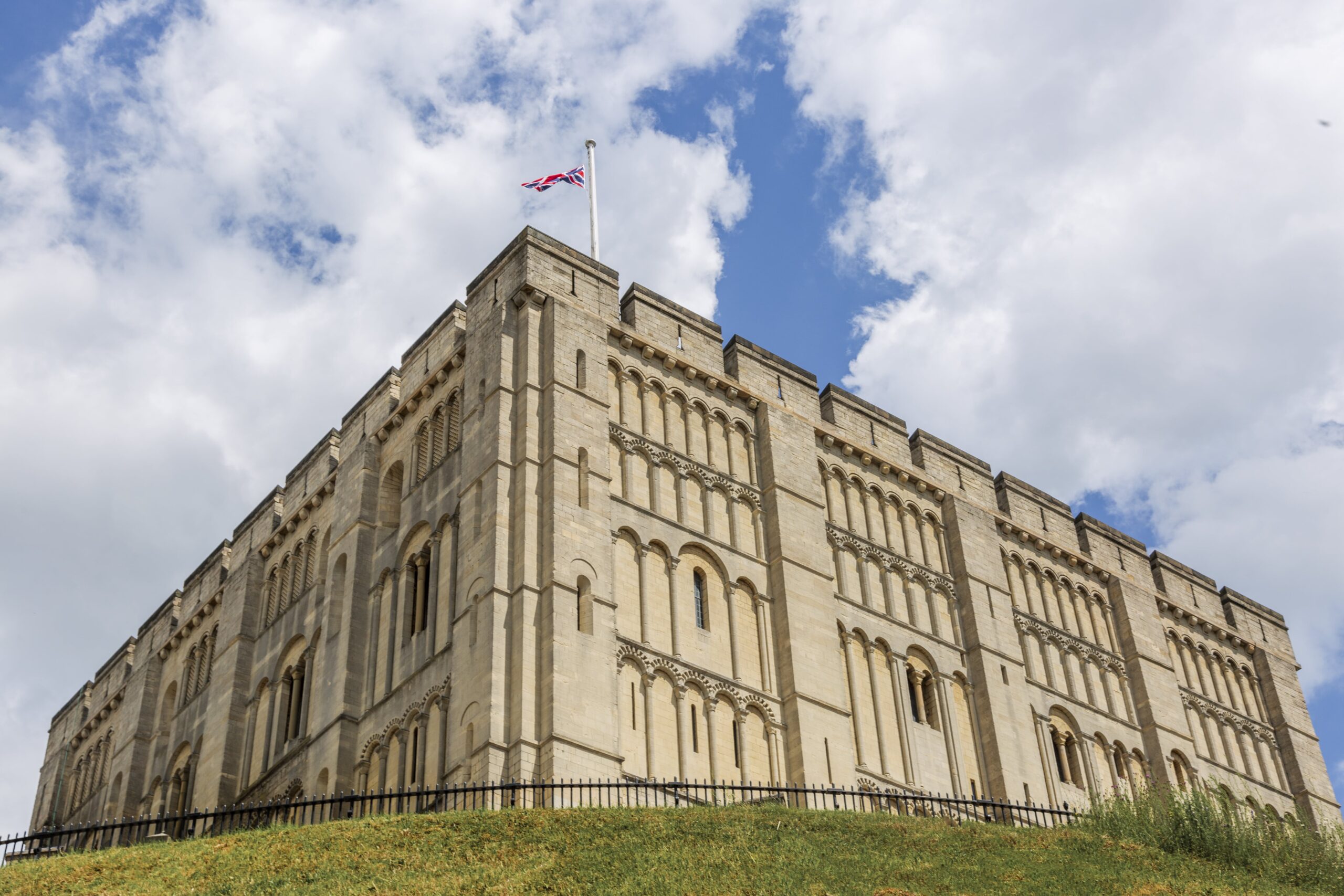
Norwich Castle wouldn’t be as it is today without the influence of Samuel Bignold
As a lover of arts and culture, Samuel Bignold was an integral part in making Norwich Castle what it is today. Without him, the south and west walls may have been demolished- and their style is in keeping with the original Norman design.
Inside, Norwich Castle Museum & Art Gallery (adults from £15.30, children from £13.05, twilight ticket 1 hour before close £2.50, book online for the best prices) is home to the world’s largest collection of works by artists from the Norwich School of Artists, including Joseph Stannar, John Crome and John Sell Cotman, of whom Samuel Bignold was a huge supporter. You can see them in the Colman Art Galleries in the galleries that were once part of the Victorian gaol.
In St Stephen’s church, you can see Bignold’s name alongside his wife’s on her monument, whilst on Surrey Street, admire the statue of Samuel Bignold on the right side of Surrey House’s entrance- once headquarters of Norwich Union, now home to Aviva. (The Bignold family lived in the grand Georgian house opposite! It’s identifiable from the grand Norwich Union clock.) Inside Surrey House, you’ll find the stunning Marble Hall- a work of architect George Skipper that you can explore with The Shoebox Experiences’ Magnificent Marble Hall tour (£16.50pp). In this interesting tour, you’ll find out more about Samuel’s life at Norwich Union- including the reason he became secretary instead of his father!
Author bio: Katie Thompson is the Marketing Executive for VisitNorwich, with a love for writing, travel, exploring different cultures and, of course, Norwich!
