
Anna Sewell
Anna Sewell
by Harriet Cooper
A pioneer in animal literature, Anna Sewell is the author of one of the best selling books of all time, Black Beauty. Not only was it the first book written from an animal’s perspective, but also altered perspectives of animal welfare and continues to do so. Here, journalist Harriet Cooper explores Anna’s story in an imagined interview.
Twenty Stories. One City. The City of Stories.
From medieval rebels and mystics to pioneering reformers, artists, entrepreneurs and unsung heroes, these are the people who shaped Norwich over 1000 years- and whose legacy can still be discovered across the city today.
All our stories are told by twenty invited guest authors from across our city’s creative, tourism and cultural community.
Delve into the series and discover the places linked to these incredible people- from museums and tours to cultural landmarks and green spaces. We kindly invite you to- Step Into The Story.
Image: Norwich BID
Stories Published So Far:
Jack Valentine | Emma de Guader | Pablo Fanque | Rumsey Wells | John Crome | Harriet Martineau | Julian of Norwich | Amelia Opie | Margaret Fountaine | Caroline Colman | George Skipper | Samuel Bignold | Margaret (Margie) Fahey McGrath | Margaret Paston | Edith Cavell
ANNA SEWELL
1820 – 1878
Anna Sewell: animal rights activist and author.
What is Black Beauty about?
I wrote the novel – the original title of which is Black Beauty: His Grooms and Companions. The Autobiography of a Horse – from the perspective of a sweet-tempered, strong-spirited horse called Black Beauty. As we follow his journey from being a happy-g0-lucky colt on a bucolic farm, all grassy meadows and babbling brooks, to pulling cabs in grimy, unforgiving London, we meet his many owners. While some are kindness personified, others are neglectful and, worse, abusive. He is a horse who experiences joy and also deep pain, but as his dear mother once said to him “do your best, whatever it is, and keep up your good name.” Black Beauty takes this advice to heart, his gentleness, intelligence and strong work ethic a beacon of hope, even in the darkest of times.
Where and why did you write Black Beauty?
In the final years of my life, an illness confined me to my bed in Old Catton, a village just outside Norwich, where I lived with my parents (I never married). It was here, between 1871 and 1877, that I wrote Black Beauty on slips of paper or dictating the words to my mother, Mary Wright Sewell, who was herself a popular children’s author. Why did I write it? To raise awareness of animal cruelty, which was heartbreakingly common in Victorian England. People didn’t treat their creatures with kindness and it filled me with anguish. Urban working horses were subjected to gruelling hours and brutal conditions; in the countryside, there was a tendency to rely on whips and tongue-lashings. And don’t get me started on the bearing rein (a harness strap used on horses to keep their heads fashionably arched). I stand by what I’ve said before, that Black Beauty was intended “to induce kindness, sympathy, and an understanding treatment of horses.” It may have been the only book I ever wrote, but I believe it has been instrumental in pioneering animal welfare. For that, I am eternally grateful.
Have you always loved animals?
Ever since I can remember. I was born into a devout Quaker family – mother Mary, father Isaac and younger brother Philip – and we all adored animals. I must have been around nine years’ old when I stood up to a horrible man who shot a blackbird in our yard. We’d often visit my extended family who lived on the Dudwick Park estate in Buxton in the Bure Valley, and that’s where I learnt to ride (it’s said that one of their horses – a lively black beast called Bess – was the inspiration for Black Beauty). One day, aged 14, I slipped on wet leaves running home from school, which left my ankles severely damaged. I was unable to ever walk properly or ride again. So I taught myself to become a carriage driver and I would drive my father – who worked as a draper, shopkeeper and commercial traveller – to and from the railway station.
Black Beauty is one of the bestselling books of all time. Did you expect it to become a global phenomenon?
Not in my wildest dreams. When I died in 1878, the book had only been published five months earlier by Jarrold & Sons of Norwich. I received a payment of £40 for the copyright. In its first year of publication it sold 12,000 copies; by 1890, over 100,000 copies. The fact it still has resonance today means everything to me. It’s been translated into many languages and sold over 50 million copies. I’ve heard that rare, well-preserved editions can go for as much as £14,000. It’s also an honour to think that author Michael Morpurgo was inspired by my work, writing War Horse from the view of the First World War horse Joey. My book’s success has also helped reinforce Norwich’s reputation as a literary city, which fills me with pride.
How important is Norfolk to you?
The county is threaded through every part of my life. I was born on 30 March 1820, in Great Yarmouth but when I was a baby, our family moved to London for my father’s work. I never much cared for towns and cities, and we would often visit my relatives in Buxton. My parents, brother and I moved many times due to my father’s work, living in Brighton, Haywards Heath and Bath, before ending up in The White House on Spixworth Road in Old Catton, where I spent the last decade of my life. My final resting place is in a Quaker burial ground in the village of Lammas.
Where can we celebrate you in Norwich and beyond?
I’m very flattered that people might want to make the pilgrimage. There is a memorial fountain at the junction of Constitution Hill and St Clement’s Hill in Norwich, which was erected by my cousin Ada Sewell in 1917 — it originally served as a horse trough. Today, it is filled with bright flowers and plants. At Upper St Giles, sit on the Norwich Book Bench where Black Beauty and I are commemorated. Out of town, you can visit the house where I was born in Great Yarmouth, with Redwings Horse Sanctuary now the custodians.
Step Into The Story.
A city you don’t just read about – you experience.
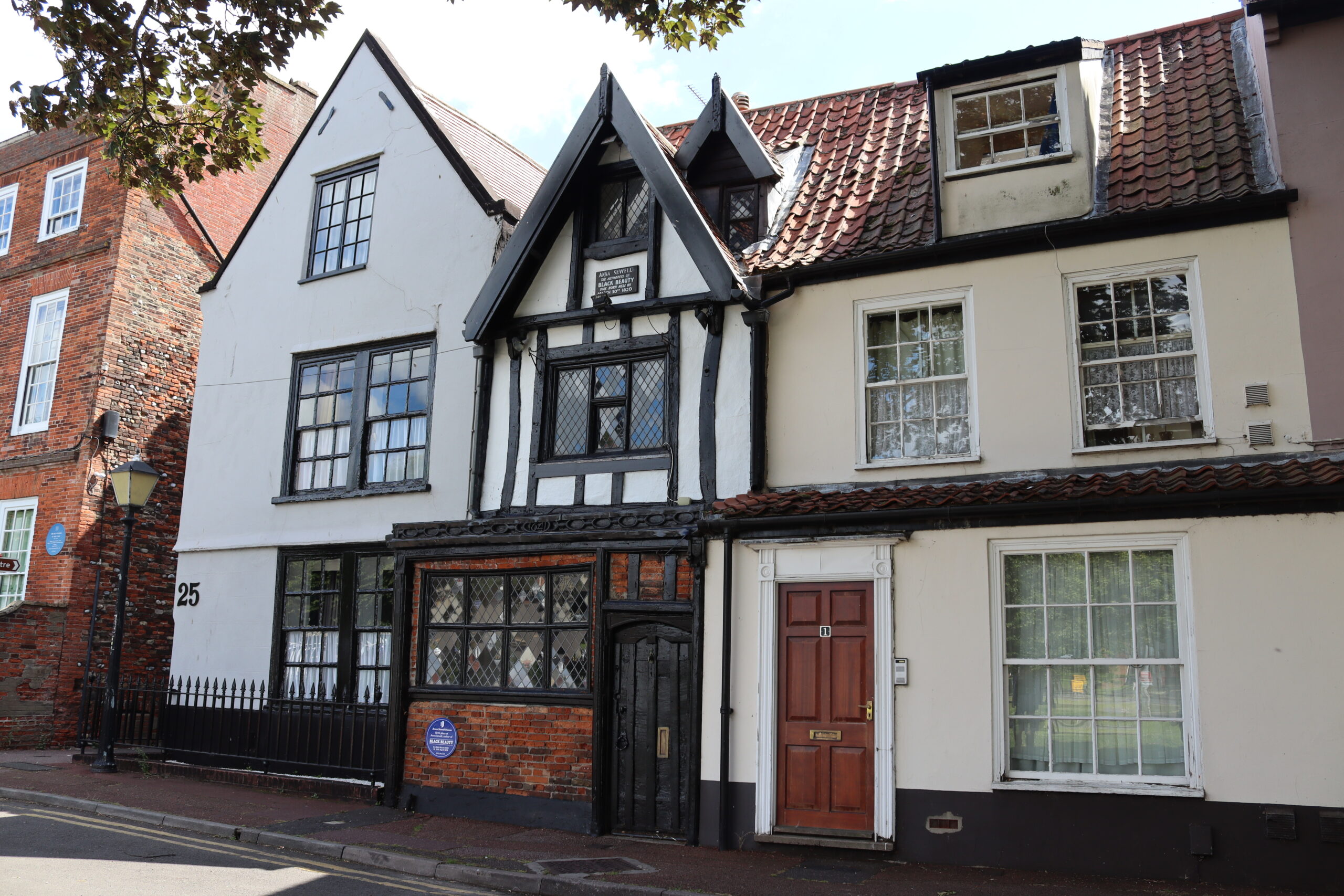
Explore Anna Sewell House in Great Yarmouth, where the author lived. Credit: Redwings Animal Sanctuary
Woven into the history of Norwich as a UNESCO City of Literature, Anna Sewell and Black Beauty are commemorated in one of Norwich’s Book Benches. You can follow the trail and take a moment, or perhaps sit with a copy of this best-selling book, on the carved book stack at Upper St Giles.
Elsewhere in the city, Sewell’s legacy is remembered with a memorial fountain- created from a horse’s trough and filled with beautiful flowers- on the corner where Constitution Hill and St Clements Hill meet, at the southern point of Sewell Park.
And in Great Yarmouth, we recommend visiting Anna Sewell’s birthplace, Anna Sewell House (Wednesday & Friday, 10am – 2pm, FREE). Dating back to the 1500s and 1600s, this Redwings Horse Sanctuary are the custodians of this historic building, where the profound influence of the author, her book on animal welfare, their legacy and Redwings’ own work are showcased.
Author bio:Harriet is an editor and journalist with almost 30 years of experience. Having worked on the editorial team at the London Evening Standard, Red magazine, British Airways High Life and luxury style guide The Glossary, she is now freelance, specialising in lifestyle, the arts and culture, and travel. She contributes to publications and platforms such as Condé Nast Traveller, The Telegraph and The Standard, as well as creating content for clients including English Heritage and 50 Best. She also works with regional outlets including North Norfolk Living magazine and Sowerbys At Home.
