
George Skipper
George Skipper
by Paul Dickson
Discover ‘Norwich’s Gaudi’, George Skipper, as part of out Twenty Stories series marking twenty years of VisitNorwich championing the city. This artistic architect’s legacy includes major works include the Art Deco Royal Arcade and stunning Marble Hall.
Twenty Stories. One City. The City of Stories.
From medieval rebels and mystics to pioneering reformers, artists, entrepreneurs and unsung heroes, these are the people who shaped Norwich over 1000 years- and whose legacy can still be discovered across the city today.
All our stories are told by twenty invited guest authors from across our city’s creative, tourism and cultural community.
Delve into the series and discover the places linked to these incredible people- from museums and tours to cultural landmarks and green spaces. We kindly invite you to- Step Into The Story.
Stories Published So Far:
Jack Valentine | Emma de Guader | Pablo Fanque | Rumsey Wells | John Crome | Harriet Martineau | Julian of Norwich | Amelia Opie | Margaret Fountaine | Caroline Colman | Samuel Bignold | Anna Sewell | Margaret (Margie) Fahey McGrath | Margaret Paston | Edith Cavell | Sir Thomas Browne | Peter the Wild Boy
GEORGE SKIPPER
1856 – 1948
The Norwich Gaudi.
The late Poet Laureate, Sir John Betjeman described George Skipper’s work as being …“altogether remarkable and original. He is to Norwich rather what Gaudi was to Barcelona.” Praise indeed for the Norfolk architect whose superb legacy can be seen in Norwich with a series of standout projects completed during the late 1890s and early 1900s.
George Skipper (1856-1948) was born in Dereham. The son of a builder, he studied fine art in Norwich and The Netherlands before heading to London to serve an architect’s apprenticeship. He returned to Norfolk in 1879 and set up his practice in Norwich a year later.
Early projects in Somerset were followed by more than a decade in Cromer creating seven hotels including the Hotel De Paris and The Cliftonville, along with the Town Hall and a range of private dwellings.
He finally turned his attention to Norwich in 1896 when he drew up plans for a new office on London Street, now part of Jarrold. It took eight years to complete the office, because he was so busy with other major schemes. The office features special decorative terracotta panels which show George on site with craftsmen, along with images of completed buildings. It was a special advert for George’s skills, at a time when professionals were just supposed to have a name plate outside their place of work.
The art nouveau masterpiece that is the Royal Arcade was George’s first completed project in Norwich, opening in 1899. Looking up is essential here to enjoy the colourful ceramic tiles by William Neatby of Royal Doulton.
Next came a wonderful building behind the Guildhall. This medieval fantasy of towers and turrets, created for the Norfolk Daily Standard newspaper, is now occupied by Indigo Tattoo Studio.
Jarrold started redeveloping their store in the early 1900’s with George as architect. The ornate London Street frontage (next to George’s office) came first, featuring the names of author’s published by Jarrold on the upper storey – another good reason to look up. This was followed after World War I with the main entrance, new restaurant on the third floor and the ornate Exchange Street frontage, completed in 1923 to mark Jarrold’s hundredth anniversary in the city.
The Haymarket area features another superb Skipper building, occupied today by Pret A Manger. Completed in 1902 for the grocer, J H Roofe, the building gently curves along the line of what used to be the tram track from Orford Place into Gentlemans Walk. The trams disappeared in the mid 1930s, but George’s grocer’s shop remains with multi-coloured terracotta, strange sea creatures and ancient Egyptian style palm fronds.
Moving onto Red Lion Street there are two further buildings, from the early 1900s, by George Skipper – Barclays Bank, commissioned by the Norfolk and Norwich Savings Bank and Commercial Chambers.
The Norfolk and Norwich Savings Bank chose George Skipper to design their new bank after its predecessor had been demolished in the Haymarket to make way for the trams. Its old site was roughly where Pret A Manger is today. The new bank has an asymmetrical roof line, typical in a Skipper building.
Commercial Chambers was the office of Charles Larking, the accountant – another building that deserves a second look. The ground floor is occupied by Gallyons, but it is the upper storey that
catches the eye with a medieval turret, an extended key stone, home to the statue of robed accountant, with a finial pointing skywards. It is said that the robed accountant is a self portrait of George Skipper.
Close by on Surrey Street is George’s largest project in the city, the Norwich Union Life Insurance Society headquarters, now Aviva. This was his first major work in stone; a contract he secured in 1901 through a national competition. Huge classical columns soar skywards topped by a pediment proudly displaying the company’s name. Inside is the building’s real treasure, the Marble Hall, decorated with multi-coloured Italian marble.
The former London and Provincial Bank on London Street, now The Ivy, is the final Skipper building to check out. Completed in 1906, it is definitely worth looking up to enjoy the decoration on the building, which highlights the bank’s name. George wanted to add a lantern with copper dome and pointed finial on top of the right hand bay. Surrounding businesses complained that they would lose too much natural light and George did not get his way, but The Ivy is still a very special creation by Norwich’s Gaudi.
Step Into The Story.
A city you don’t just read about – you experience.
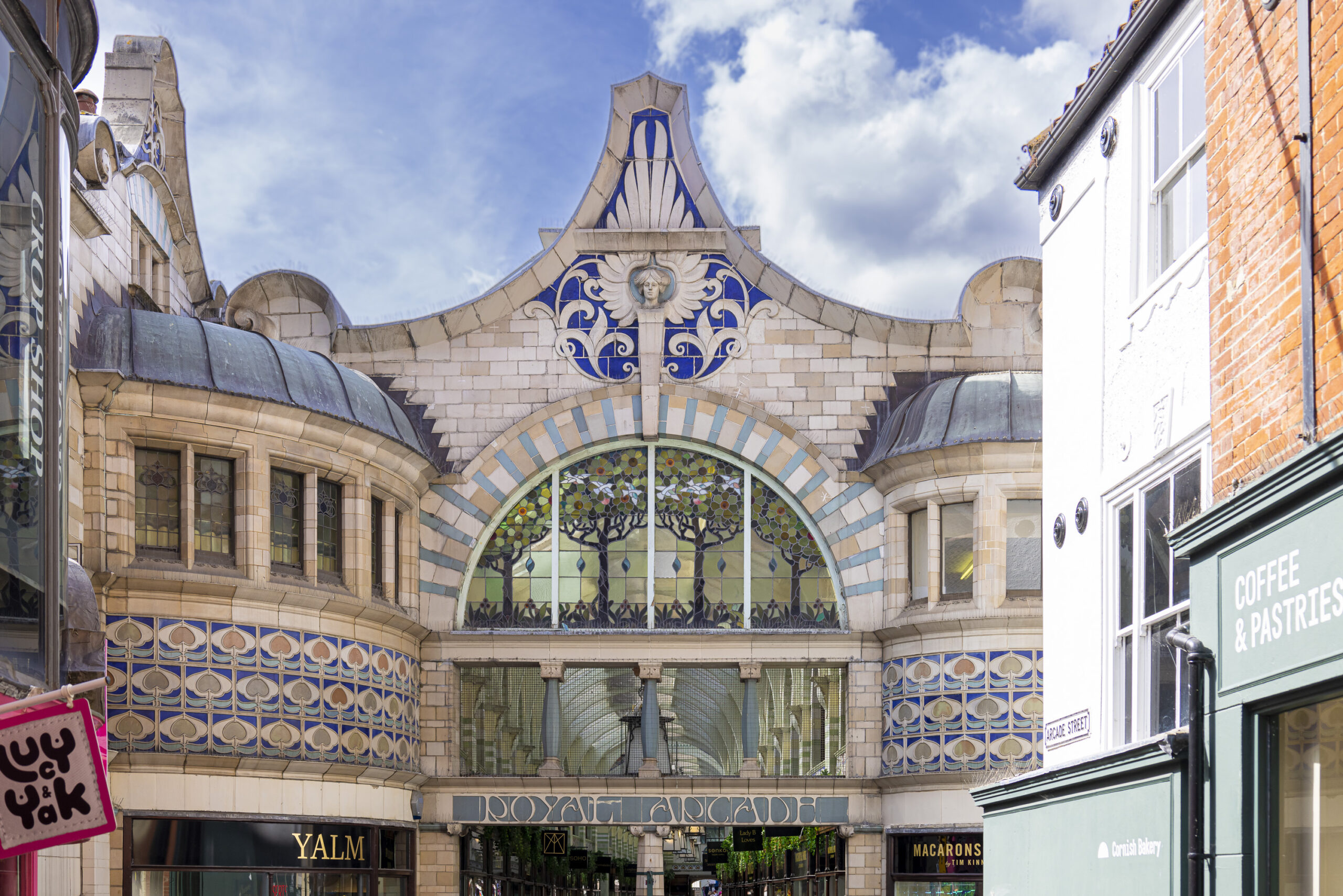
The Royal Arcade is probably the most striking and recognisable of Skipper’s works
If you remember one thing when it comes to George Skipper, it’s ‘look up’!
His works are scattered throughout the city (and Cromer, if you’re visiting the Norfolk coast), on display for all to admire. Buildings on London Street, Haymarket, Red Lion Street and St Giles can all be attributed to his artistic visions.
One of the most impressive is the Royal Arcade. This stunning Art Deco design features beautiful tiling from the man who tiled Harrods, depicting angels and nature, as well as a bright glass ceiling. And on the fringes of the Norwich Lanes, take a look at Jarrolds. Admire the grand London Street frontage before strolling a short way down Little London Street. Now part of Jarrolds, the former site of Skipper’s office is decorated in intricate terracotta tiles depicting detailed scenes. Take a moment to take them in!
To find out more about the stories behind them, join Paul Dickson’s Boardman & Skipper tour (£9pp), celebrating the architects’ styles and legacy across 90 minutes. Elsewhere, The Shoebox Experiences will take you into the breathtaking interior of Skipper’s Marble Hall on Surrey Street- some of his finest work (£16.50pp).
Author bio: Paul Dickson is a tour guide who offers a range of tours in Norwich, Cromer and the Norfolk Broads. George Skipper features in tours in both Cromer and Norwich: www.pauldicksontours.co.uk.
